The Cleveland Museum of Art
Collection Online as of April 25, 2024
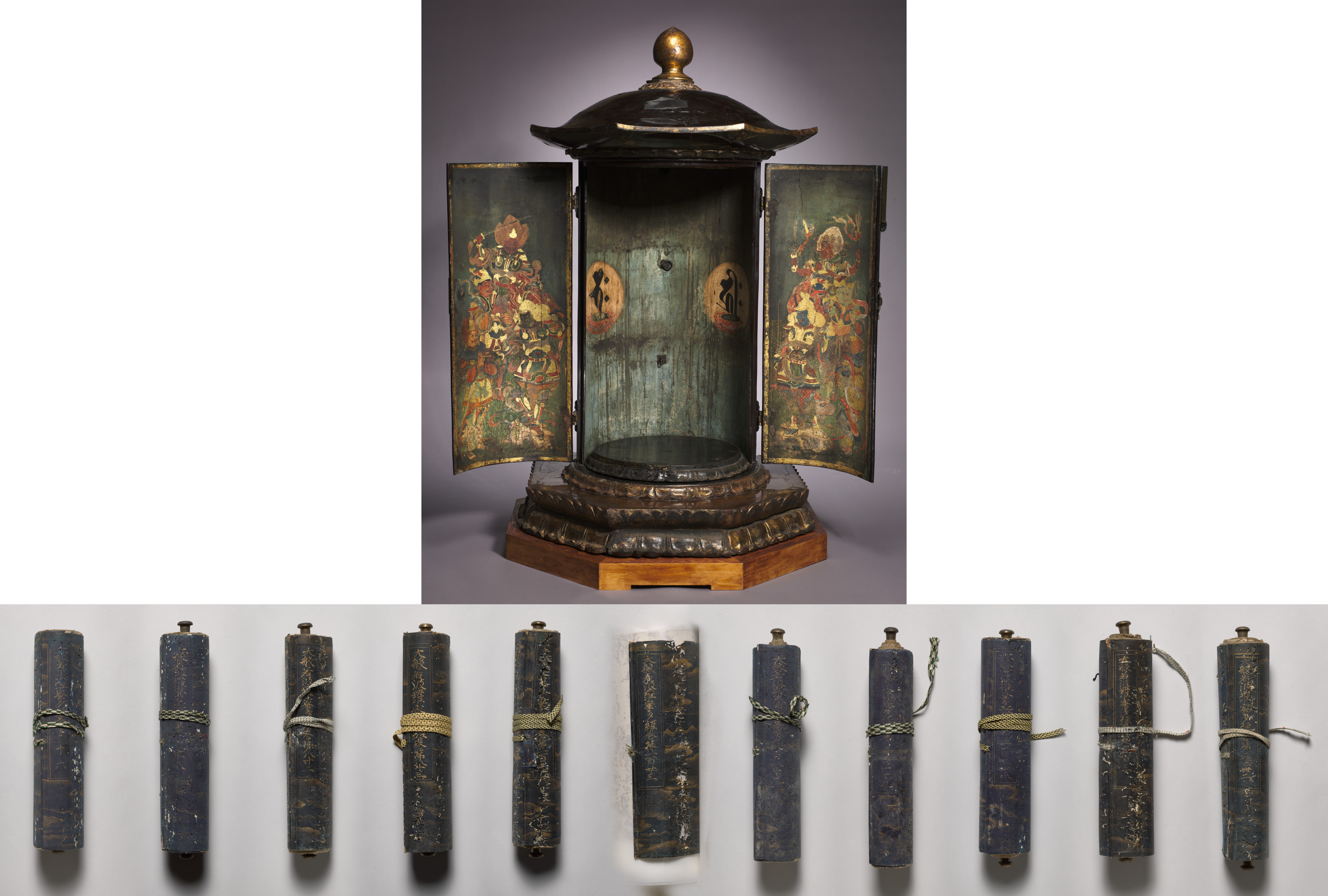
Repository for the Great Perfection of Wisdom Sutra and Eleven Volumes of the Great Perfection of Wisdom Sutra
late 1100s
Location: not on view
Did You Know?
The mate to this object is in the Nara National Museum in Japan.Description
This repository is one of a pair that once contained the scrolls of a religious text called the Great Perfection of Wisdom Sutra. Two discs painted on the back have the sacred syllables representing the Buddha Shakyamuni and the Buddha Amida. Eight of the 16 benevolent but fierce looking deities who protect the text appear on the doors.- Kamigamosha [Kamigamo Shrine], Kyoto, JapanJinkō'in, Kyoto, Japan?-1969(Shogoro Yabumoto, Amagasaki, Hyōgo Prefecture, Japan, sold to the Cleveland Museum of Art)1969-The Cleveland Museum of Art, Cleveland, OH
- Lee, Sherman E. “The Year in Review for 1969.” The Bulletin of the Cleveland Museum of Art, vol. 57, no. 1, 1970, pp. 2–50. Reproduced: no. 236, p. 35; Mentioned: p. 51 www.jstor.org“Art of Asia Recently Acquired by American Museums, 1969.” Archives of Asian Art, vol. 24, 1970, pp. 86–117. Reproduced: fig. 8, p. 88; Mentioned: p. 87 www.jstor.org"New Oriental art galleries at Cleveland." Apollo: A Journal of the Arts. August 1970, Vol. 92, pp. 148-151. Mentioned and Reproduced: fig. 4, p. 149The Cleveland Museum of Art. Handbook of the Cleveland Museum of Art/1978. Cleveland, OH: The Cleveland Museum of Art, 1978. Reproduced: p. 371 archive.orgYamane, Yūzō 山根有三. Zaigai bijutsu [在外美術 = Selections of Japanese Art from Western Collections]. Tōkyō: Shōgakukan, 1994. Reproduced: pp. 223, 236, no. 134Cunningham, Michael R., Stanislaw J. Czuma, Anne E. Wardwell, and J. Keith Wilson. Masterworks of Asian Art. Cleveland: Cleveland Museum of Art, 1998. Reproduced: pp. 188-189May, Sally Ruth, Jane Takac, and Barbara J. Bradley. Knockouts: A Pocket Guide. Cleveland: Cleveland Museum of Art, 2001. Reproduced: no. 88, p. 82; Mentioned p. 119Grossman, Nancy, James T. Ulak, Marjorie Williams, and Laurence Channing. Art of Japan: Masterpieces from the Cleveland Museum of Art. Cleveland, Ohio: Cleveland Museum of Art, 2005. Reproduced: p. 27"Stories from Storage." The Asian Art Newspaper: Monthly for Collectors, Dealers, Museums and Galleries 24, no. 5: 6-7. Mentioned and reproduced: pp. 6-7
- Stories From Storage. The Cleveland Museum of Art, Cleveland, OH (organizer) (February 7-May 16, 2021).Gallery 237 (Japanese and Korean Art). The Cleveland Museum of Art, Cleveland, OH (April 23, 2013-November 17, 2015)Streams and Mountains Without End: Asian Art and the Legacy of Sherman E. Lee at the Cleveland Museum of Art. The Cleveland Museum of Art, Cleveland, OH (organizer) (June 27-August 23, 2009).An Historical Reunion: Daihannyakyo Buddhist Tabernacles from The Cleveland Museum of Art and the Nara National Museum. Nara National Museum, Nara, Japan. (April 29-May 21, 2000). Exhibition of the CMA repository newly conserved through the Research Institute for Cultural Properties program with the Nara National Museum's repository.The Past Century of Nara National Museum - From Preaching Scene of Shakyamuni to Picture Scroll of Kusamakura. Nara National Museum (organizer) (April 26-June 1, 1997).Year in Review: 1969. The Cleveland Museum of Art, Cleveland, OH (organizer) (January 27-February 22, 1970).
- {{cite web|title=Repository for the Great Perfection of Wisdom Sutra and Eleven Volumes of the Great Perfection of Wisdom Sutra|url=false|author=|year=late 1100s|access-date=25 April 2024|publisher=Cleveland Museum of Art}}
Source URL:
https://www.clevelandart.org/art/1969.130