The Cleveland Museum of Art Announces 2026 Exhibition Schedule
- Press Release
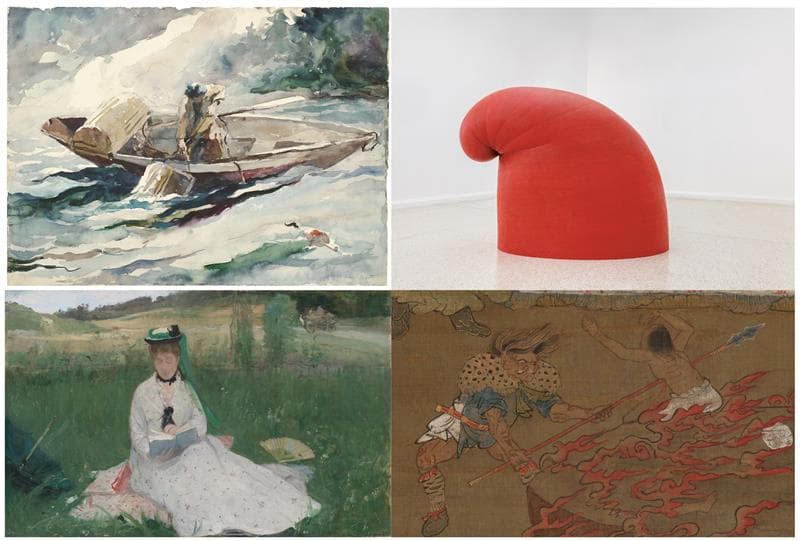
Clockwise from top left: Maine Fisherman, 1936. Andrew Wyeth (American, 1917–2009). Watercolor on paper; 55.9 x 76.8 cm. Wyeth Foundation for American Art Collection, P0656. © 2025 Wyeth Foundation for American Art / Artists Rights Society (ARS), New York. Big Phrygian, 2010–14. Martin Puryear (American, b. 1941). Painted red cedar; 147.3 x 101.6 x 193 cm. Glenstone Museum, Potomac, Maryland. © Martin Puryear, courtesy of Matthew Marks Gallery. Reading, 1873. Berthe Morisot (French, 1841–1895). Oil on canvas; 46 x 71.8 cm. The Cleveland Museum of Art, Gift of the Hanna Fund, 1950.89. The Fourth King of Hell (detail), late 1300s. Korea, Goryeo dynasty (918–1392). Hanging scroll; ink, color, and gold ink on silk; 136.2 x 58.9 cm. The Cleveland Museum of Art, Leonard C. Hanna Jr. Fund and museum purchase from various donors by exchange and partial gift of the Honorable Joseph P. Carroll and Roberta Carroll, MD, 2019.224
Contact the Museum's Media Relations Team:
(216) 707-2261
marketingandcommunications@clevelandart.org
The CMA marks its 110th anniversary with Spectacular Freedom: Andrew Wyeth and the Modern American Watercolor; Martin Puryear: Nexus; Manet & Morisot; Ten Kings of Hell and the Afterlife in Medieval Korea; and more.
Featured Exhibitions
Spectacular Freedom: Andrew Wyeth and the Modern American Watercolor
September 20, 2026–January 18, 2027
The Kelvin and Eleanor Smith Foundation Gallery
Press Kit (opens in a new tab)

Explore Andrew Wyeth’s innovative watercolor practice through nearly 75 works from the artist’s estate—most never previously exhibited—alongside a selection of his tempera paintings. Spectacular Freedom: Andrew Wyeth and the Modern American Watercolor offers a fresh perspective on a celebrated American artist’s early decades, highlighting his engagement with watercolor at a time when it was seen as a national medium, distinctively suited to depicting American experiences.
Spectacular Freedom: Andrew Wyeth and the Modern American Watercolor is organized by the Cleveland Museum of Art in association with the Wyeth Foundation for American Art, with support from the Andrew & Betsy Wyeth Study Center of the Brandywine Museum of Art.
Presented by the Wyeth Foundation for American Art
April 12–August 9, 2026
The Kelvin and Eleanor Smith Foundation Exhibition Hall and Gallery 224B
Press Kit (opens in a new tab)

Martin Puryear’s (American, born 1941) singular work across mediums illuminates the expressive potential for abstraction in our time. Martin Puryear: Nexus highlights the global histories that have inspired Puryear’s practice, offering a fresh and timely perspective on his impactful body of work. While accentuating the art’s visual allure, this exhibition and its accompanying catalogue shed light on the ways that the artist’s unique visual vocabulary has been shaped by his enduring interests in global traditions of material culture, African American history, and the natural world.
Presented by the Henry Luce Foundation, the Terra Foundation for American Art, and the Andy Warhol Foundation for the Visual Arts
Principal support is provided by the late Agnes Gund. Generous support is provided by the Gottlob family in loving memory of Milford Gottlob, MD, and the National Endowment for the Arts. Additional support is provided by Kenneth H. Kirtz and family.
March 29–July 5, 2026
The Kelvin and Eleanor Smith Foundation Gallery
Press Kit (opens in a new tab)

Manet & Morisot is the first ever major exhibition dedicated to the artistic exchange between Édouard Manet, often referred to as the father of modern painting, and Berthe Morisot, the only woman among the founding members of the Impressionist movement. Through comparisons of related works made between the late 1860s and the late 1880s, this exhibition traces the evolution of a singular friendship between two groundbreaking artists.
This exhibition is organized by the Fine Arts Museums of San Francisco in collaboration with the Cleveland Museum of Art.
Presented by Bank of America
Ten Kings of Hell and the Afterlife in Medieval Korea
October 11, 2026–January 3, 2027
The Kelvin and Eleanor Smith Foundation Exhibition Hall
Press Kit (opens in a new tab)

Organized in partnership with the National Museum of Korea, Ten Kings of Hell: The Afterlife in Medieval Korea is a landmark exhibition that explores how medieval Koreans envisioned the world beyond death and how artistic materials shaped that imagined realm. Featuring rare and important works from the Goryeo dynasty (918–1392), the exhibition unfolds across three sections tracing the soul’s passage from death through purgatory to Buddhist paradise. At its dramatic center is the historic reunification of a dispersed set of 10 hanging scrolls depicting the 10 Kings of Hell. Brought together for the first time since the 1960s, the scrolls offer a rare opportunity to experience the panoramic sequence of judgment and salvation. Adding to this momentous occasion, two Goryeo Buddhist paintings—Avalokiteśvara and Kṣitigarbha—make their public debut, the former newly attributed to the Goryeo period and the latter never before exhibited.
A selection of contemporary works further underscores the enduring resonance of humanity’s existential questions. Park Chan-kyong’s Belated Bosal (2019) confronts viewers with human-induced environmental catastrophes and their karmic consequences. Gala Porras-Kim’s The Third King of Hell Afterimage (2025), created specifically for this exhibition by the 2025 MacArthur Fellow, not only make the reunion of the 10 Kings of Hell at the CMA possible, but also critically examines the afterlives of objects within Western collecting practices.
Presented by the National Museum of Korea
Principal support is provided by Dr. Conrad C. and Patricia V. Simpfendorfer. Major support is provided by the Malcolm E. Kenney Curatorial Research Fund. Additional support is provided by the Joseph M. and Bonnie N. S. Gardewin Endowment for Korean Art Exhibitions and Ms. Judith Gerson.
Newly Announced
still/emerging: Native American Works on Paper
February 1–June 7, 2026
James and Hanna Bartlett Prints and Drawings Galleries
Press Kit (opens in a new tab)

still/emerging: Native American Works on Paper is the first exhibition to highlight the Cleveland Museum of Art’s rapidly expanding collection of prints and drawings by Native American artists. Around 30 works created from the 1950s through today highlight the unique histories and perspectives of Indigenous artists from a number of backgrounds and tribal affiliations.
This exhibition is made possible with support from the Malcolm E. Kenney Curatorial Research Fund.
Epic of the Northwest Himalayas: Pahari Paintings from the “‘Shangri’ Ramayana”
April 19–August 16, 2026
Julia and Larry Pollock Focus Gallery
Press Kit (opens in a new tab)

In blazing colors, the story of the Ramayana unfolds across 40 paintings reunited from an extensive series made around 300 years ago in the mountainous Hindu kingdoms of northern India. More than 100 additional pages are presented in digitally animated sequences, revealing dramatic visual narrations and unexpected climaxes.
The exhibition celebrates the publication of the Catherine Glynn Benkaim and Ralph Benkaim Collection of Pahari paintings, which includes three pages of the “Shangri” Ramayana that are on view and contextualized in Epic of the Northwest Himalayas.
Principal support is provided by William Roj and Mary Lynn Durham. Generous support is provided by the Bagri Foundation.
France in the Time of “Manet & Morisot”
May 10–August 23, 2026
Mark Schwartz and Bettina Katz Photography Galleries
Press Kit (opens in a new tab)

Édouard Manet and Berthe Morisot lived during a tumultuous yet fertile period in France. Events included war and the loss of territory, modernization and the rise of industry, and a shift from rural to urban living. As both artists were living in Paris, it became the largest city in continental Europe and the arts capital of the world. Manet and Morisot’s lifetimes also coincided with the birth and rise of a new art form—photography—which recorded many of these social, political, and cultural changes.
In this exhibition, drawn from the museum’s rich holdings of 19th-century French photography, we can feel that we, like the photographers, are eyewitnesses to the transformation of France in the 19th century. This show is organized to complement Manet & Morisot, on view in the Kelvin and Eleanor Smith Foundation Gallery from March 29 through July 5, 2026.
The Renaissance Engraver at Work
July 5–November 1, 2026
James and Hanna Bartlett Prints and Drawings Galleries
Press Kit (opens in a new tab)

The Cleveland Museum of Art holds some of the world’s rarest and most important early engravings. Through works from the collection, The Renaissance Engraver at Work explores the innovations and adaptations as well as the beauty and astounding optical effects that shaped the early history of engraving in Europe.
The Gift: Emma Amos with Friends
September 20, 2026–January 24, 2027
Mark Schwartz and Bettina Katz Photography Galleries
Press Kit (opens in a new tab)

Emma Amos: Among Friends centers on Amos’s monumental portrait series The Gift (1990–94), which was recently acquired by the Cleveland Museum of Art. This suite of 48 watercolor portraits, painted from life, depicts women artists, writers, and curators in Amos’s intergenerational community. Made as a birthday present for her daughter India, The Gift animates the importance of creative kinship as a source of strength, support, and inspiration, which Amos learned from her mother. Marking the first time The Gift has been displayed in nearly 20 years, this exhibition as well as its accompanying catalogue and digital resource illuminate the context for this work’s production and its legacies.
Juste-Aurèle Meissonnier: Rococo Goldsmith in Focus
October 25, 2026–March 14, 2027
Julia and Larry Pollock Focus Gallery
Press Kit (opens in a new tab)

Juste-Aurèle Meissonnier (French, born Italy, 1695–1750) was the most revolutionary forerunner of the Rococo style in the decorative arts. Considered a genius goldsmith by his contemporaries, he was also a prolific designer and aspiring architect, maneuvering between media and disciplines. Few of his works survived political upheavals; the most celebrated is a silver tureen in the collection of the Cleveland Museum of Art, which has recently undergone scientific analysis that has provided new insights into its sophisticated creation process. Accompanied by a lavishly illustrated publication, this exhibition offers a fresh perspective on an artist who deserves broader recognition.
Major support is provided by the Malcolm E. Kenney Curatorial Research Fund.
Print Revolutions: Chinese Impressions 1630–1960
November 15, 2026–April 4, 2027
James and Hanna Bartlett Prints and Drawings Galleries
Press Kit (opens in a new tab)

China invented printmaking and papermaking as well as color printing with multiple blocks. The exhibition celebrates the CMA’s recent acquisition of Suzhou prints from the 1700s that present a high point of color printing in China. Around 60 prints, paintings, and porcelains illustrate the development of color printing in China from the 1600s and the international modern woodcut movement in the early 1900s.
Major support is provided by the MCH Foundation. Additional support is provided by the Gramercy Park Foundation.
Stunning Patterns: Woven Textiles from Madagascar’s Merina Kingdom
December 6, 2026–November 7, 2027
Arlene M. and Arthur S. Holden Gallery
Press Kit (opens in a new tab)

The first American exhibition on Malagasy textiles in over 20 years and the first worldwide on Merina textiles, Stunning Patterns: Woven Textiles from Madagascar’s Merina Kingdom weaves a dynamic story of royalty, resistance, reinvention, and resilience as told through the history of eastern African silk weaving. The exhibition highlights an important new acquisition of a contemporary Malagasy silk textile alongside historical textiles, depictions of Malagasy elites wearing them, and a new short film on weaving that brings perspectives from Madagascar to the Midwest. Focusing on the Merina Kingdom (c. 1540–1897, also called Imerina) and people, it considers how changing political, economic, and environmental factors affected the lamba, a pan-Malagasy woven textile used as a garment or shroud.
All exhibitions at the Cleveland Museum of Art are underwritten by the CMA Fund for Exhibitions. Principal annual support is provided by Michael Frank and the late Pat Snyder, the Kelvin and Eleanor Smith Foundation, the John and Jeanette Walton Exhibition Fund, and Margaret and Loyal Wilson. Major annual support is provided by the late Dick Blum and Harriet Warm and the Frankino-Dodero Family Fund for Exhibitions Endowment. Generous annual support is provided by two anonymous donors, Gini and Randy Barbato, Cynthia and Dale Brogan, Dr. Ben and Julia Brouhard, Brenda and Marshall Brown, Gail and Bill Calfee, the Leigh H. Carter family, Dr. William A. Chilcote Jr. and Dr. Barbara S. Kaplan, Mary and Jim Conway, Joseph and Susan Corsaro, Ron and Cheryl Davis, Richard and Dian Disantis, the Jeffery Wallace Ellis Trust in memory of Lloyd H. Ellis Jr., Leigh and Andy Fabens, Florence Kahane Goodman, Martha H. and Steven M. Hale, Janice Hammond and Edward Hemmelgarn, Linda Harper, Robin Heiser, the late Marta and the late Donald M. Jack Jr., the estate of Walter and Jean Kalberer, Mrs. Nancy M. Lavelle, Eva and Rudolf Linnebach, William S. Lipscomb, Bill and Joyce Litzler, Lu Anne and the late Carl Morrison, Peta Moskowitz, Jeffrey Mostade and Eric Nilson and Varun Shetty, Sarah Nash, Courtney and Michael Novak, Tim O’Brien and Breck Platner, Dr. Nicholas and Anne Ogan, William J. and Katherine T. O’Neill, Henry Ott-Hansen, the Pickering Foundation, Christine Fae Powell, Peter and Julie Raskind, Michael and Cindy Resch, Marguerite and James Rigby, William Roj and Mary Lynn Durham, in memory of Dee Schafer, Betty T. and David M. Schneider, Elizabeth and Tim Sheeler, Saundra K. Stemen, Paula and Eugene Stevens, the Womens Council of the Cleveland Museum of Art, and Claudia Woods and David Osage.
The Cleveland Museum of Art is funded in part by residents of Cuyahoga County through a public grant from Cuyahoga Arts & Culture.
The exhibitions program at the Cleveland Museum of Art is supported in part by the Ohio Arts Council, which receives support from the State of Ohio and the National Endowment for the Arts.
###
About the Cleveland Museum of Art
The Cleveland Museum of Art (CMA) is renowned for the quality and breadth of its collection, which includes more than 66,500 artworks and spans 6,000 years of achievement in the arts. The museum is a significant international forum for exhibitions, scholarship, and performing arts and is a leader in digital innovation. One of the foremost encyclopedic art museums in the United States, the CMA is recognized for its award-winning open access program—which provides free digital access to images and information about works in the museum’s collection—and is free of charge to all. The museum is located in the University Circle neighborhood with two satellite locations on Cleveland’s west side: the Community Arts Center and Transformer Station.
The museum is supported in part by residents of Cuyahoga County through a public grant from Cuyahoga Arts & Culture and made possible in part by the Ohio Arts Council (OAC), which receives support from the State of Ohio and the National Endowment for the Arts. The OAC is a state agency that funds and supports quality arts experiences to strengthen Ohio communities culturally, educationally, and economically. For more information about the museum and its holdings, programs, and events, call 888-CMA-0033 or visit cma.org.