The Cleveland Museum of Art Celebrates Ohio-born Artist Ann Hamilton in Multisensory Exhibition
- Press Release
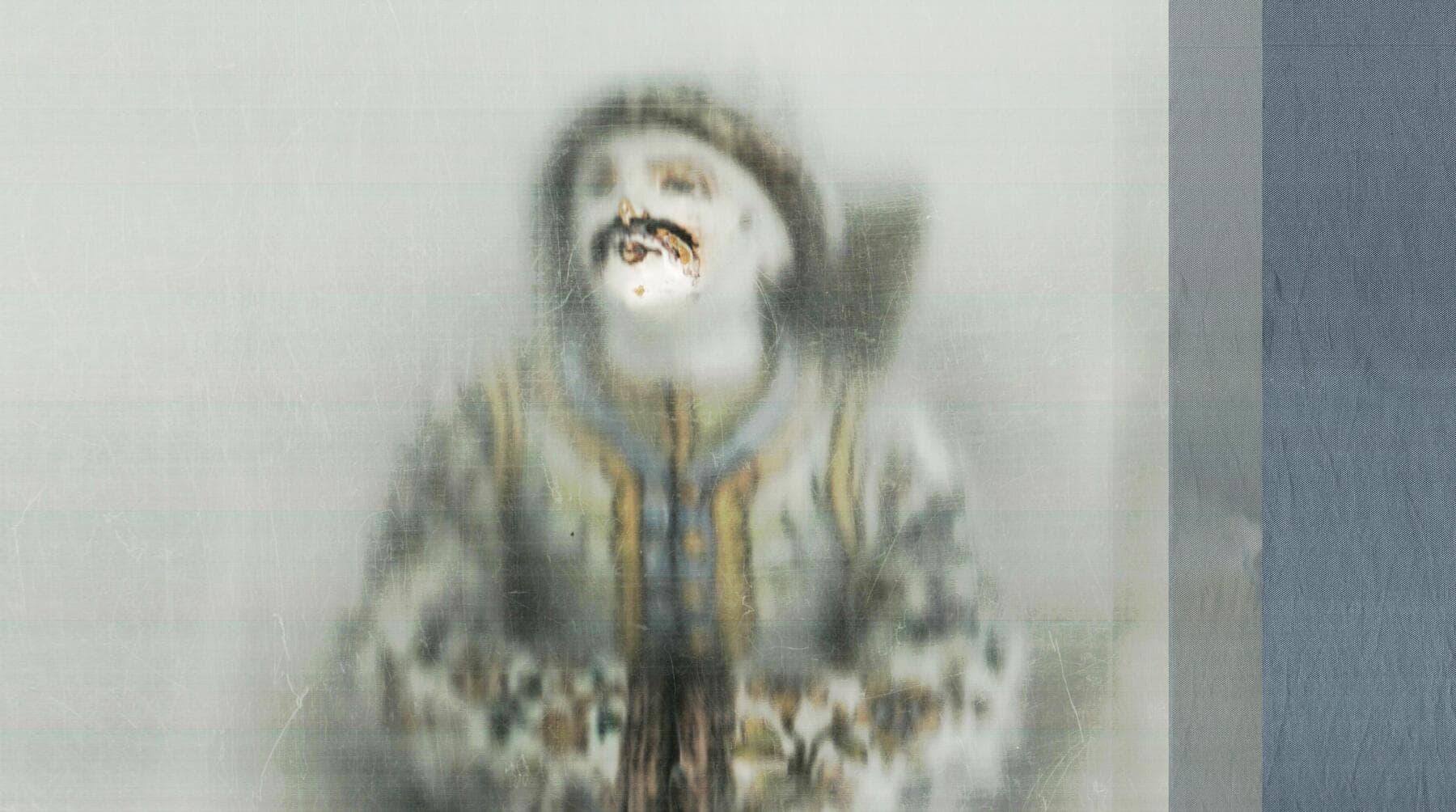
cadence (detail 1), 2025. Ann Hamilton (American, b. 1956). Pigment print; size variable. Courtesy of the artist
Contact the Museum's Media Relations Team:
(216) 707-2261
marketingandcommunications@clevelandart.org
New Exhibition Ann Hamilton: still and moving • the tactile image explores rarely displayed objects from the CMA’s collection in a completely new medium
Cleveland (December 12, 2025)—In the Cleveland Museum of Art’s (CMA) newest exhibition, Ann Hamilton: still and moving • the tactile image, internationally renowned artist Ann Hamilton used a handheld scanner to bring to life objects in the CMA’s collection that are rarely on display: small-scale figurative ceramics and crèche figures from 1300s to the 1800s. The result is a visually stunning exhibition with monumental images of the diminutive sculptures that explores the relationship between the senses, especially touch, sight, and language through photography, video, and sound. In Hamilton’s work, the sculptures become characters joined in a story that is implied but never told.

Born in Lima, Ohio, and living in Columbus, Hamilton is among Ohio’s most influential and best-known artists. Among her many honors are the National Medal of the Arts, the MacArthur Fellowship, the Heinz Award, and the Guggenheim Memorial Fellowship.
On view Sunday, December 14, 2025, through Sunday, April 19, 2026, Ann Hamilton: still and moving • the tactile image spans Toby’s Gallery for Contemporary Art and the Mark Schwartz and Bettina Katz Photography Galleries. This show re-presents the CMA’s objects in an enveloping surround that newly interconnects these objects with our senses.
“Where am I? What is here? Who is here? These are the questions that internationally renowned artist Ann Hamilton asks herself at the beginning of every project. From these questions she finds the appropriate medium, form, and physical manifestation with which to respond to the site or occasion,” said Barbara Tannenbaum, curator of photography, chair of prints, drawings, and photographs.
Visitors will use several senses to experience the exhibition, which begins with 14-foot-tall photographs in the Mark Schwartz and Bettina Katz Photography Galleries.
To create these mammoth depictions of the CMA’s small-scale figurative sculptures, Hamilton used a handheld wand scanner. Due to the nature of the technology, the wand had to remain in physical contact with a surface, so Hamilton rolled it over a thin sheet of plastic which she placed over or around the sculptures. Moving the wand, the sculptures, or both, Hamilton was drawing with lens and light, a reminder that the scanner is a photographic medium. Through this technology, she brought the complex, twisting shapes of these figurative sculptures to life.


Time is also an inherent component of scanning. A traditional still photograph captures a single moment, but a scan requires movement over an extended interval. Since the goal was expression rather than replication, that movement can become a dance between object and scanner, a tango that creates distortion. Hamilton’s blurred images suggest the capture of a gesture, the register of a glance. In this way, she imparts a sense of animation and of the passage of time to these figures who have been frozen in form and space. Two horns in the gallery carry the sound of whistling. Hamilton says, “If sound is how we touch at a distance, whistling is one of its furthest reaches: a call that we turn toward like a bell or shaft of light.”
The second of the exhibition’s two galleries, Toby’s Gallery for Contemporary Art, presents examples from Hamilton’s use of photography over her 40-year career, starting with her first photographic project, the body object series from the mid-1980s, and moves on to later photographic projects including videos, all of which employ the medium in a nontraditional manner.

But it is video that dominates the second gallery. Three spinning videos, two of which were created for this exhibition, circle the walls. Made with a miniature surveillance camera, all three feature movement of both the subject and the camera, creating a rhythm and sense of animation in the footage. They ask us to consider the act of making, to explore the concept of turning—rotating in space but also transforming—and the relationship between touch and language.
Accompanying the exhibition is an elegant, intriguing publication that is part artist’s book, part exhibition catalogue. A scholarly essay by Barbara Tannenbaum, the first to focus on Hamilton’s use of photography, sets this newest work by Hamilton in the context of the artist’s career-long exploration of the medium. The 320-page book is published by the Cleveland Museum of Art and distributed by Yale University Press. It retails for $65 and is available at the museum’s store.
Related Programming
The Fran and Warren Rupp Contemporary Artist Lecture
Sunday, February 22, 2026, 2:00–3:00 p.m.
Gartner Auditorium, Suzanne and Paul Westlake Performing Arts Center
Free; Ticket Required

All exhibitions at the Cleveland Museum of Art are underwritten by the CMA Fund for Exhibitions. Principal annual support is provided by Michael Frank and the late Pat Snyder, the Kelvin and Eleanor Smith Foundation, the John and Jeanette Walton Exhibition Fund, and Margaret and Loyal Wilson. Major annual support is provided by the late Dick Blum and Harriet Warm and the Frankino-Dodero Family Fund for Exhibitions Endowment. Generous annual support is provided by two anonymous donors, Gini and Randy Barbato, Cynthia and Dale Brogan, Dr. Ben and Julia Brouhard, Brenda and Marshall Brown, Gail and Bill Calfee, the Leigh H. Carter family, Dr. William A. Chilcote Jr. and Dr. Barbara S. Kaplan, Mary and Jim Conway, Joseph and Susan Corsaro, Ron and Cheryl Davis, Richard and Dian Disantis, the Jerry Wallace Ellis Trust in memory of Lloyd H. Ellis Jr., Leigh and Andy Fabens, Florence Kahane Goodman, Martha H. and Steven M. Hale, Janice Hammond and Edward Hemmelgarn, Linda Harper, Robin Heiser, the late Marta and the late Donald M. Jack Jr., the estate of Walter and Jean Kalberer, Mrs. Nancy M. Lavelle, Eva and Rudolf Linnebach, William S. Lipscomb, Bill and Joyce Litzler, Lu Anne and the late Carl Morrison, Peta Moskowitz, Jeffrey Mostade and Eric Nilson and Varun Shetty, Sarah Nash, Courtney and Michael Novak, Tim O’Brien and Breck Platner, Dr. Nicholas and Anne Ogan, William J. and Katherine T. O’Neill, Henry Ott-Hansen, the Pickering Foundation, Christine Fae Powell, Peter and Julie Raskind, Michael and Cindy Resch, Marguerite and James Rigby, William Roj and Mary Lynn Durham, in memory of Dee Schafer, Betty T. and David M. Schneider, Elizabeth and Tim Sheeler, Saundra K. Stemen, Paula and Eugene Stevens, the Womens Council of the Cleveland Museum of Art, and Claudia Woods and David Osage.
The Cleveland Museum of Art is funded in part by residents of Cuyahoga County through a public grant from Cuyahoga Arts & Culture.
This exhibition was supported in part by the Ohio Arts Council, which receives support from the State of Ohio and the National Endowment for the Arts.
###
About the Cleveland Museum of Art
The Cleveland Museum of Art (CMA) is renowned for the quality and breadth of its collection, which includes more than 66,500 artworks and spans 6,000 years of achievement in the arts. The museum is a significant international forum for exhibitions, scholarship, and performing arts and is a leader in digital innovation. One of the foremost encyclopedic art museums in the United States, the CMA is recognized for its award-winning open access program—which provides free digital access to images and information about works in the museum’s collection—and is free of charge to all. The museum is located in the University Circle neighborhood with two satellite locations on Cleveland’s west side: the Community Arts Center and Transformer Station.
The museum is supported in part by residents of Cuyahoga County through a public grant from Cuyahoga Arts & Culture and made possible in part by the Ohio Arts Council (OAC), which receives support from the State of Ohio and the National Endowment for the Arts. The OAC is a state agency that funds and supports quality arts experiences to strengthen Ohio communities culturally, educationally, and economically. For more information about the museum and its holdings, programs, and events, call 888-CMA-0033 or visit cma.org.