The Cleveland Museum of Art Presents its Largest-Ever Fashion Exhibition, Renaissance to Runway: The Enduring Italian Houses
- Press Release
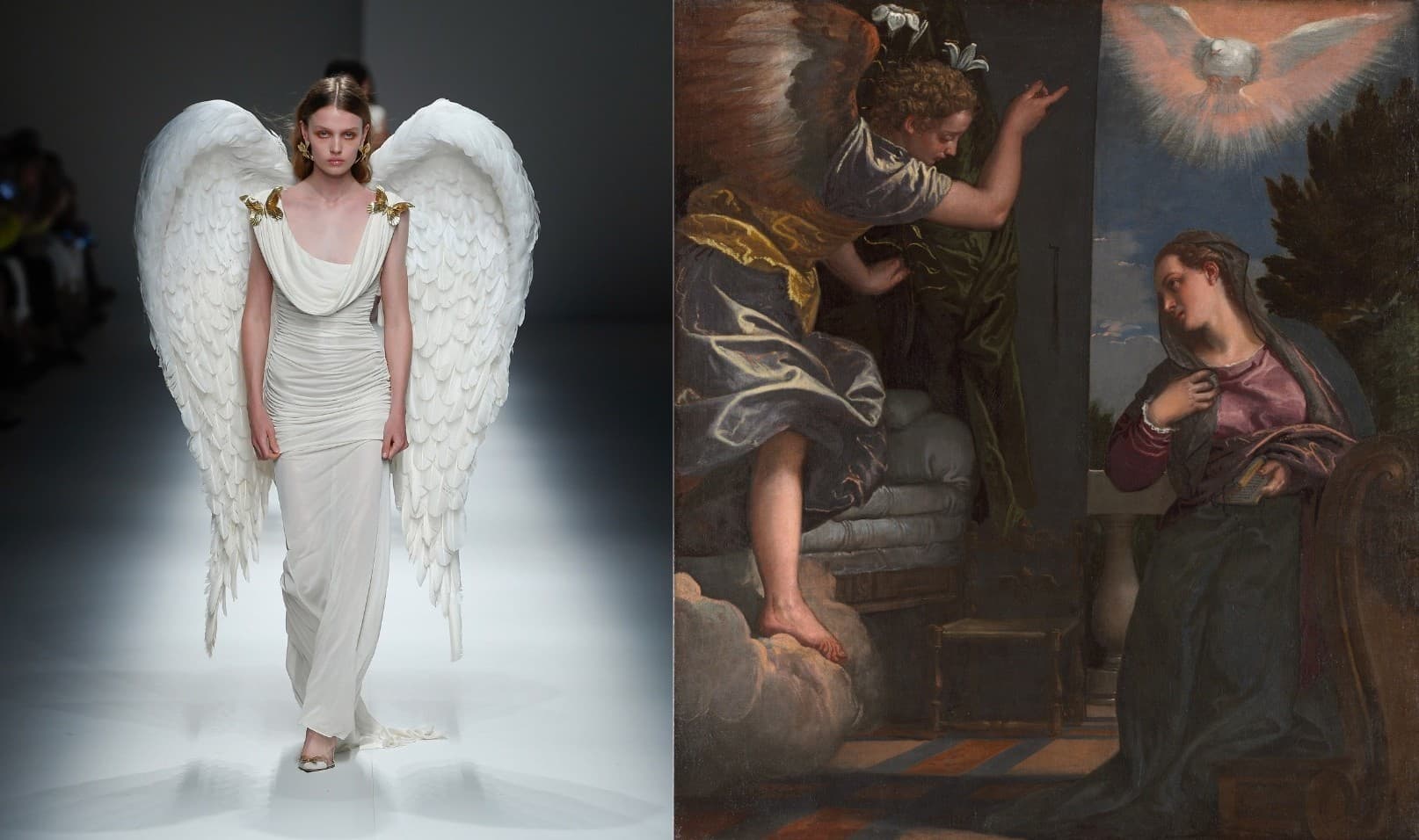
Left: Evening Dress and Wings, spring 2024. Nicola Brognana (Italian, b. 1990) for Blumarine (Italy, est. 1977). Viscose, feathers, brass. Courtesy of Blumarine. Photo: Giovanni Giannoni / WWD via Getty Images. © Getty Images
Right: The Annunciation, c. 1580. Paolo Veronese (Italian, 1528–1588) and Workshop. Oil on canvas. The Cleveland Museum of Art, Gift of the Hanna Fund, 1950.251
Contact the Museum's Media Relations Team:
(216) 707-2261
marketingandcommunications@clevelandart.org
From Versace and Valentino to Ferragamo and Capucci, 80 ensembles and garments and 40 jewelry pieces are on view in this first-of-its-kind Italian fashion exhibition.
Cleveland (November 4, 2025)—See the past and present converse through fashion. Presenting centuries apart, still stitched together, Renaissance to Runway: The Enduring Italian Houses explores more than 100 modern and contemporary Italian fashions and accessories in dialogue with Italian fine, decorative, and textile arts from the 1400s to the early 1600s in the Cleveland Museum of Art’s (CMA) newest exhibition.
Ensembles and stylistic examples from a range of storied houses, such as Armani, Buccellati, Bvlgari, Capucci, Ferragamo, Gucci, Valentino, Versace, and more, are on view Sunday, November 9, 2025, through February 1, 2026, in the Kelvin and Eleanor Smith Foundation Exhibition Hall.
Artworks from the Italian Renaissance, Mannerist, and early Baroque periods from the CMA’s world-renowned collection are paired with range of couture, or alta moda, and adjacently classified fashions and accessories, conveying the historical period’s cultural preservation within and influence on 20th- and 21st-century Italian fashion designers and houses. Similarly, early modern artwork from around the world is also visually reproduced using various mediums to illuminate the breadth of inspirations. The exhibition presents approximately 80 ensembles and garments and 40 jewelry pieces.
Exhibition Highlights

Designed with the imagination of the early modern period in mind, this evening dress intertwines metal threads in floral patterns that cascade down its burgundy velvet skirt, reminiscent of the opulent weave structure and decorative techniques of Italian historical textile production. Red was a beloved color for Italian early modern textiles that was often achieved through kermes- and, eventually, cochineal-based dyestuffs. A version of this gown was remade for Blake Lively’s red-carpet appearance at the 2018 Met Gala in conjunction with the Heavenly Bodies: Fashion and the Catholic Imagination exhibition.

For this collection, Alberta Ferretti poetically referenced 15th- and 16th-century dress styles popular throughout the Italian peninsula. The emphasized lace around this ensemble’s blouse alludes to the evolution of lace collars, particularly in women’s fashion, from partlets to ruffs, throughout the 1500s. Additionally, the dress’s higher unnatural waistline draws attention to movement of such silhouettes through the 1400s and early 1500s.

When Mario Buccellati founded his house, he built its design principles on the history and techniques of Renaissance goldsmiths, and these principles have persisted through the creative direction of each generation of the house. This pendant, with its symmetrical and rigid diamond setting, was inspired by the facade of Renaissance palaces, expanding the scope of references that Italian fashion houses and designers have interpreted.

Based in Rome, Bvlgari, rooted in the vision of its founder, a Greek-born silversmith, Sotirio Voulgaris, also has origins directly aligning with Italian early modern art ideals, especially those that look to ancient Greco-Roman art to propel inventiveness. Reinforcing Voulgaris’s vision, this necklace emphasizes a sardonyx-engraved likeness of Medusa, an ancient Greek mythological figure whose image also transcended into ancient Roman art, and eventually Italian early modern art, most famously, in Caravaggio’s 1596 Medusa masterwork.

Salvatore Ferragamo was infatuated with integrating Italian Renaissance and early modern references in his designs, fusing them with his academic knowledge of foot anatomy. In 1956, Ferragamo was commissioned by an American client to create an 18-karat gold sandal, for which he engraved the heel and straps with a vine-like flora design, suggesting the exuberance exuded by Italian early modern art involving floral patterns. In 2023, paying homage to Ferragamo, the newly appointed creative director of Ferragamo, Maximilian Davis, created this version of the sandal in a laminated leather, fit for the comforts of contemporary fashion while extenuating the same elegance as the original design.

For much of his career, Giorgio Armani played with the elements of the Italian early modern period, fusing them with his other global passions. The rippling layers of this feathered cape from the fall 2018 privé collection suggest the legacy of feathers in Italian style through the ages. During the early modern period, feathers were often slight accoutrements for men’s hats, used to soften projected bravado but still adhering to the standard of sprezzatura. Still a symbol of flair, the feathers of this silhouette by Mr. Armani add to the history of theatricality in Italian fashion.

For this collection, Nicola Brognano looked to angels for inspiration, conveying tonal effervescence and delicate implications in his garments. This dress’s flowing structure implies emotional gentleness as it ideologically articulates the essence of angels as represented in the opulent imagery of Italian early modern art, particularly in works with Catholic and Christian themes.
Tickets for this highly anticipated exhibition are now on sale. The CMA recommends reserving tickets through its online platform by visiting the Renaissance to Runway exhibition webpage. Tickets can also be reserved by phone at 216-421-7350 or on-site at one of the ticket desks.
Programming
MIX: Renaissance to Revolution
Friday, November 7, 2025, 6:00–10:00 p.m.
Ames Family Atrium
“Alien Superstars,” be prepared to “Cuff It” at MIX: Renaissance to Revolution, which celebrates the opening of Renaissance to Runway: The Enduring Italian Houses, the largest CMA fashion exhibition in the museum’s history. Guests enjoy an evening themed around another Renaissance—the disco-and-house realm of Beyoncé’s Renaissance. Throughout the evening, you can “Virgo’s Groove” to the musings of DJ Lily Jade and DJ Black Unicorn, who spin sets of music featuring and inspired by Mrs. Carter’s discography. Bring incredible “Energy,” donning your best interpretations of Mrs. Carter’s Renaissance era. This is a night of “Heated” fun where a ticket to MIX grants you admission into the Renaissance to Runway exhibition. Guests are encouraged to strut down our red-carpet photo-op to savor the moment. Enjoy themed food and drink items, including Italian-inspired cuisine, cocktails, beer, and wine for purchase from Bon Appétit.
Disclaimer: No full-face masks, heavy face paint, glitter, weaponlike props, or excessively oversize costumes are permitted. All outfits are subject to security screening. The Cleveland Museum of Art may refuse entry to any visitor whose attire does not comply with these requirements.
Coloring “Renaissance to Runway”: Fashioning Red in Italian Fashion
Tuesday, December 2, 2025, 12:00–1:00 p.m.
Gartner Auditorium, Suzanne and Paul Westlake Performing Arts Center
During the Italian early modern period, the color red was prominently adopted into style, becoming a symbol of luxury. Created using various dyestuffs, including those derived from insects such as the kermes and the cochineal, red was a symbol of power. Its essence has transcended time, conveying similar connotations in contemporary Italian fashion, which highlights the color’s connections to exuberant elegance and sensuality. Presented by the associate curator of fashion, Darnell-Jamal Lisby, this lunchtime lecture explores how the color red helped define various narratives elicited by the Renaissance to Runway: The Enduring Italian Houses project. From Giorgio Armani to Gianfranco Ferré, from Versace to Alberta Ferretti, red represents a line from the past into the present and future modes of creativity.
Catalogue
Accompanying the exhibition is a richly illustrated, 200-page catalogue, art directed by former 30-year Vogue Italia artistic director, Luca Stoppini, written by the exhibition’s curator, Darnell-Jamal Lisby, and with contributions by Dr. Matteo Augello, curator, lecturer, and author of Curating Italian Fashion; Alessandra Arezzi Boza, archivist, curator, and founder of Studio AAB; Massimiliano Capella, director of the house museum of the Paolo and Carolina Zani Foundation for Art and Culture; Luke Meagher (@HautLeMode), fashion critic and social media influencer; and Stefania Ricci, director of the Ferragamo Museum. Additionally, the exhibition includes a digital installation produced by internationally celebrated creative director Francesco Carrozzini and globally renowned artist Henry Hargreaves, offering their take on the exhibition’s subject. Altogether, Renaissance to Runway is an amalgamation of the expansive dynamism and commemoration of Italian creativity.
This exhibition is presented by the John P. Murphy Foundation.

Major support is provided by Courtney and Michael Novak. Generous support is provided by Sandra and the late Richey Smith and the Carol Yelling Family Fund.
All exhibitions at the Cleveland Museum of Art are underwritten by the CMA Fund for Exhibitions. Principal annual support is provided by Michael Frank and the late Pat Snyder, the Kelvin and Eleanor Smith Foundation, the John and Jeanette Walton Exhibition Fund, and Margaret and Loyal Wilson. Major annual support is provided by the late Dick Blum and Harriet Warm and the Frankino-Dodero Family Fund for Exhibitions Endowment. Generous annual support is provided by two anonymous donors, Gini and Randy Barbato, Cynthia and Dale Brogan, Dr. Ben and Julia Brouhard, Brenda and Marshall Brown, Gail and Bill Calfee, the Leigh H. Carter family, Dr. William A. Chilcote Jr. and Dr. Barbara S. Kaplan, Joseph and Susan Corsaro, Ron and Cheryl Davis, Richard and Dian Disantis, the Jeffery Wallace Ellis Trust in memory of Lloyd H. Ellis Jr., Leigh and Andy Fabens, Florence Kahane Goodman, Janice Hammond and Edward Hemmelgarn, Robin Heiser, the late Marta and the late Donald M. Jack Jr., the estate of Walter and Jean Kalberer, Mrs. Nancy M. Lavelle, Eva and Rudolf Linnebach, the William S. Lipscomb Fund, Bill and Joyce Litzler, Lu Anne and the late Carl Morrison, Jeffrey Mostade and Eric Nilson and Varun Shetty, Sarah Nash, Courtney and Michael Novak, Tim O’Brien and Breck Platner, Dr. Nicholas and Anne Ogan, William J. and Katherine T. O’Neill, Henry Ott-Hansen, the Pickering Foundation, Christine Fae Powell, Peter and Julie Raskind, Michael and Cindy Resch, Marguerite and James Rigby, William Roj and Mary Lynn Durham, in memory of Dee Schafer, Betty T. and David M. Schneider, Elizabeth and Tim Sheeler, Saundra K. Stemen, Paula and Eugene Stevens, the Womens Council of the Cleveland Museum of Art, and Claudia Woods and David Osage.
###
About the Cleveland Museum of Art
The Cleveland Museum of Art (CMA) is renowned for the quality and breadth of its collection, which includes more than 66,500 artworks and spans 6,000 years of achievement in the arts. The museum is a significant international forum for exhibitions, scholarship, and performing arts and is a leader in digital innovation. One of the foremost encyclopedic art museums in the United States, the CMA is recognized for its award-winning open access program—which provides free digital access to images and information about works in the museum’s collection—and is free of charge to all. The museum is located in the University Circle neighborhood with two satellite locations on Cleveland’s west side: the Community Arts Center and Transformer Station.
The museum is supported in part by residents of Cuyahoga County through a public grant from Cuyahoga Arts & Culture and made possible in part by the Ohio Arts Council (OAC), which receives support from the State of Ohio and the National Endowment for the Arts. The OAC is a state agency that funds and supports quality arts experiences to strengthen Ohio communities culturally, educationally, and economically. For more information about the museum and its holdings, programs, and events, call 888-CMA-0033 or visit cma.org.