Epic of the Northwest Himalayas: Pahari Paintings from the “‘Shangri’ Ramayana” Opens at the Cleveland Museum of Art
- Press Release
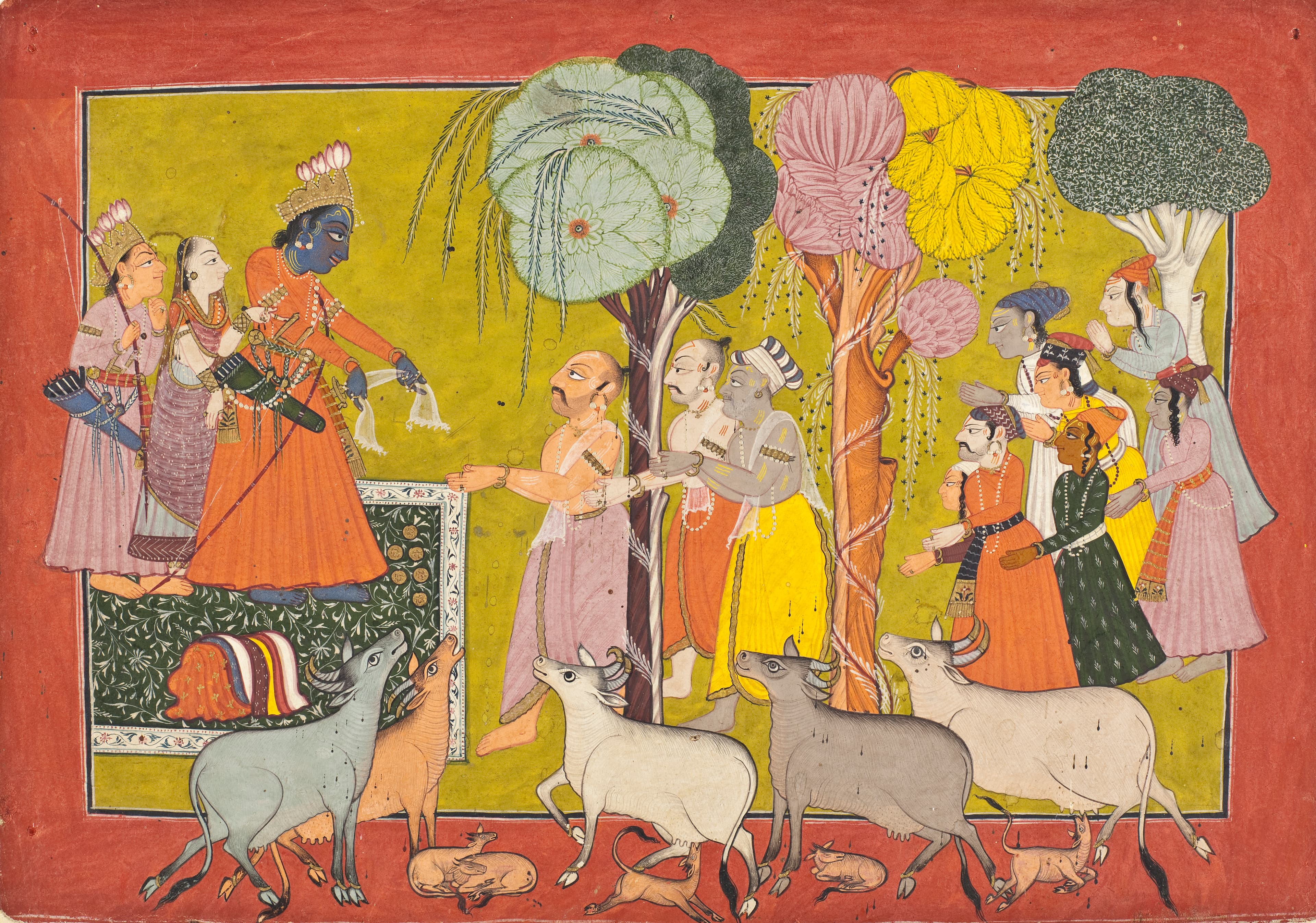
Rama bestows his possessions on the Brahmans, his friends, and his servants, from the “Shangri” Ramayana, c. 1700. Northern India, Pahari kingdoms. Gum tempera and gold on paper; 22.2 x 31.4 cm. Los Angeles County Museum of Art, From the Nasli and Alice Heeramaneck Collection, Museum Associates Purchase, M.77.19.22. Digital image © 2025 Museum Associates / LACMA. Licensed by Art Resource, NY
Contact the Museum's Media Relations Team:
(216) 707-2261
marketingandcommunications@clevelandart.org
Magic abounds in 40 paintings reunited from a widely dispersed pictorial series that presents the story of the Hindu divine hero Rama
CLEVELAND (April 17, 2026)—Potent themes of righteousness, vengeance, and loyalty are explored through dramatic episodes in which demons are vanquished, lovers are separated, and monkeys, bears, and a man-eagle save the day in the Cleveland Museum of Art’s (CMA) newest exhibition, Epic of the Northwest Himalayas: Pahari Paintings from the “‘Shangri’ Ramayana.” On view from Sunday, April 19, through Sunday, August 16, 2026, in the Julia and Larry Pollock Focus Gallery, Epic of the Northwest Himalayas reunites paintings from a widely dispersed pictorial series that presents the story of the Hindu divine hero Rama. The exhibition is free and open to all.
The story of Rama is a timeless tale more than 2,000 years old, which remains a cultural force across southern Asia. Along with the 40 paintings, three digital stations positioned throughout the exhibition feature more than 100 gently animated images of paintings from multiple collections reassembled into their original episodic sequences.

Created with blazing colors for a royal collection around 1700, the “Shangri” Ramayana has been a beloved and enigmatic series among scholars and collectors for the past century. New evidence from previously unpublished paintings reveals a wider range of artistic styles and shows that the total number of folios is three times greater than previously recognized. It argues in favor of a collaborative model of production involving artists from across the alpine region of Pahari India, which straddles the present-day state of Himachal Pradesh and that of Jammu and Kashmir.
The unbound pictorial series began to be divided as early as the 1760s, suggesting that its spiritual merit was intended to be shared among multiple owners. Its title derives from the kingdom of Shangri, where a member of the royal family sold his 275 folios to a dealer in Delhi, beginning in 1962. Hundreds more paintings, however, have been in other royal collections.
“Epic of the Northwest Himalayas presents not only the narrative arc of this influential and timeless story but also exciting new research on distinctive patronage and painting systems in the valley kingdoms of Pahari India,” said Sonya Rhie Mace, George P. Bickford Curator of Indian and Southeast Asian Art.

Focusing on a single series, the exhibition introduces visitors to the experience of viewing paintings that were made together but became separated over time. Using digital image animation to showcase select passages of sequential folios that cannot be physically displayed together, the three videos create an astonishing minute-by-minute unfolding of scenes that culminate in previously unrecognized climaxes becoming apparent. Both cinematic and operatic when viewed together, the paintings also stand brilliantly alone as individual works of art.
Epic of the Northwest Himalayas and the related installation, Pahari Paintings: Art and Stories in the CMA’s gallery 242B, are part of a larger project connecting the Cleveland Museum of Art (CMA), the Cincinnati Art Museum (CAM), and the Smithsonian’s National Museum of Asian Art in Washington, DC (NMAA). All three museums have recently acquired Pahari paintings from the Catherine Glynn Benkaim and Ralph Benkaim Collection. Alongside India-based scholars, curators from these three museums have worked collaboratively to study, publish, and display Pahari paintings from the Benkaim Collection. Their efforts have come to fruition in the publication Pahari Paintings: Art and Stories and in exhibitions being presented at the CMA, CAM, and NMAA during the spring and summer of 2026.
The exhibition celebrates the publication of the Catherine Glynn Benkaim and Ralph Benkaim Collection of Pahari paintings, which includes three pages of the “Shangri” Ramayana that are on view and contextualized in Epic of the Northwest Himalayas.
Principal support is provided by William Roj and Mary Lynn Durham. Major support is provided by V. V. Rajadhyaksha, DLZ Corp.

Generous support is provided by the Bagri Foundation.

All exhibitions at the Cleveland Museum of Art are underwritten by the CMA Fund for Exhibitions. Principal annual support is provided by Michael Frank and the late Pat Snyder, the Kelvin and Eleanor Smith Foundation, the John and Jeanette Walton Exhibition Fund, and Margaret and Loyal Wilson. Major annual support is provided by the late Dick Blum and Harriet Warm and the Frankino-Dodero Family Fund for Exhibitions Endowment. Generous annual support is provided by two anonymous donors, Gini and Randy Barbato, Cynthia and Dale Brogan, Dr. Ben and Julia Brouhard, Brenda and Marshall Brown, Gail and Bill Calfee, the Leigh H. Carter family, Dr. William A. Chilcote Jr. and Dr. Barbara S. Kaplan, Mary and Jim Conway, Joseph and Susan Corsaro, Ron and Cheryl Davis, Richard and Dian Disantis, the Jeffery Wallace Ellis Trust in memory of Lloyd H. Ellis Jr., Leigh and Andy Fabens, Florence Kahane Goodman, Martha H. and Steven M. Hale, Janice Hammond and Edward Hemmelgarn, Linda Harper, Robin Heiser, the late Marta and the late Donald M. Jack Jr., the estate of Walter and Jean Kalberer, Robert M. Kaye, Jane and Doug Kern, the late Mrs. Nancy M. Lavelle, Eva and Rudolf Linnebach, William S. Lipscomb, Bill and Joyce Litzler, the Roy Minoff Family Fund, Lu Anne and the late Carl Morrison, Mrs. Peta and the late Dr. Roland Moskowitz, Jeffrey Mostade and Eric Nilson and Varun Shetty, Sarah Nash, Courtney and Michael Novak, Tim O’Brien and Breck Platner, Dr. Nicholas and Anne Ogan, William J. and Katherine T. O’Neill, Henry Ott-Hansen, the Pickering Foundation, Frank and Fran Porter, Christine Fae Powell, Peter and Julie Raskind, Michael and Cindy Resch, Marguerite and James Rigby, in memory of Dee Schafer, Betty T. and David M. Schneider, Elizabeth and Tim Sheeler, Saundra K. Stemen, Paula and Eugene Stevens, the Womens Council of the Cleveland Museum of Art, and Claudia Woods and David Osage.
Major support for the exhibition catalogue is provided by an anonymous donor.
Complementary Gallery Rotation
Pahari Paintings: Art and Stories
Through Sunday, August 23, 2026
Gallery 242B
Free; No Ticket Required
In the far north of India, the Himalayan mountain ranges rise abruptly from the Punjab plains to form the alpine region known as Pahari, defined by a shared language (Pahari) and script (Takri). From the 1600s to 1900s, the Hindu nobility of the Pahari kingdoms commissioned paintings for their royal collections. Known as “Pahari paintings,” they were made by painters who were born into hereditary artist communities located in villages throughout the region. By the end of the 1900s, many descendants of royal families dispersed them, and they became some of the most popular and widely collected genres of Indian painting in the world.
This installation celebrates the CMA’s 2018 acquisition and 2026 publication of the Pahari paintings from the renowned Catherine Glynn Benkaim and Ralph Benkaim Collection. It includes portraits of key patrons, a large-scale historical painting on cloth, and paintings of religious and poetic subjects. A special feature on paintings from a mystical romance, the Madhavanala-Kamakandala, reveals the complex dynamic between visual and literary arts, the sacred and the secular, Hindu and Muslim, local and mainstream. Two double-sided embroideries, known as rumal, showcase textile art made by Pahari women in collaboration with painters who were predominantly men. These 23 works of art summarize the scope of Pahari painting.
Complementary Programs
The Dr. Ranajit K. Datta Distinguished Lecture in Indian Art
Interpreting Sita’s Abduction in Early Indian Art
Sunday, May 3, 2026, 2:00–3:00 p.m.
Gartner Auditorium
Free; Ticket Required
Surprisingly, the earliest depictions of the dramatic scene of Sita’s abduction in the Ramayana, a fundamentally Hindu text, are found rather in early Buddhist contexts ranging from 200 BCE to 200 CE. Besides sculptures and other archaeological finds, versions of this story also appear in ancient Buddhist and Jain texts from different regions, written in languages such as Prakrit, Pali, and Chinese. Does this suggest that ancient religious identities were more flexible than previously thought? Additionally, the prevalence of Sita’s abduction shows that stories about the abduction of women were very popular. Does this reflect how society at the time normalized a patriarchal view of desire?
Naman P. Ahuja is a professor at Jawaharlal Nehru University, New Delhi, specializing in South Asia’s art history. He is the general editor of Marg and a curator who, through his numerous publications and exhibitions, has drawn attention to the foundations of Indian visual iconography and aesthetics, the simultaneous demands of decolonization and transculturalism as well as matters of gender and religious culture.

“Crucible of Honor”: Indian Dance Theatre with Live Orchestra
Sunday, August 2, 2026, 2:00–3:30 p.m.
Gartner Auditorium
Ticket Required
On Sale Sunday, April 19, 2026
Rooted in the classical language of Bharatanatyam (Indian classical dance), this production brings to life the timeless epic of the Ramayana, portraying Rama as divinity in human form, the embodiment of integrity, justice, and heroism. Tested at every turn, Rama remains unwavering in his commitment to righteousness over personal desire. This dance theater production with live music celebrates one of the world’s most enduring tales in conjunction with the CMA exhibition Epic of the Northwest Himalayas.
“Crucible of Honor” is produced by Bharatanatyam exponent Sujatha Srinivasan, an award-winning choreographer and artistic director of Shri Kalaa Mandir Dance Company. It features distinguished dancers accompanied by a live Indian musical ensemble.
The views expressed by performers during this event are their own and do not necessarily reflect the opinions of the Cleveland Museum of Art.
About the Cleveland Museum of Art
The Cleveland Museum of Art (CMA) is renowned for the quality and breadth of its collection, which includes more than 66,500 artworks and spans 6,000 years of achievement in the arts. The museum is a significant international forum for exhibitions, scholarship, and performing arts and is a leader in digital innovation. One of the leading encyclopedic art museums in the United States, the CMA is recognized for its award-winning open access program—which provides free digital access to images and information about works in the museum’s collection—and free of charge to all. The museum is located in the University Circle neighborhood with two satellite locations on Cleveland’s west side: the Community Arts Center and Transformer Station.
The museum is supported in part by residents of Cuyahoga County through a public grant from Cuyahoga Arts & Culture and made possible in part by the Ohio Arts Council (OAC), which receives support from the State of Ohio and the National Endowment for the Arts. The OAC is a state agency that funds and supports quality arts experiences to strengthen Ohio communities culturally, educationally, and economically. For more information about the museum and its holdings, programs, and events, call 888-CMA-0033 or visit cma.org.