Artwork Page for Globular Pot

Details / Information for Globular Pot

Globular Pot

25–50 CE
Measurements
Diameter: 21 cm (8 1/4 in.); Overall: 20.5 cm (8 1/16 in.)
Credit Line
Public Domain
You can copy, modify, and distribute this work, all without asking permission. Learn more about CMA's Open Access Initiative.
Location
103 Roman
?

Did You Know?

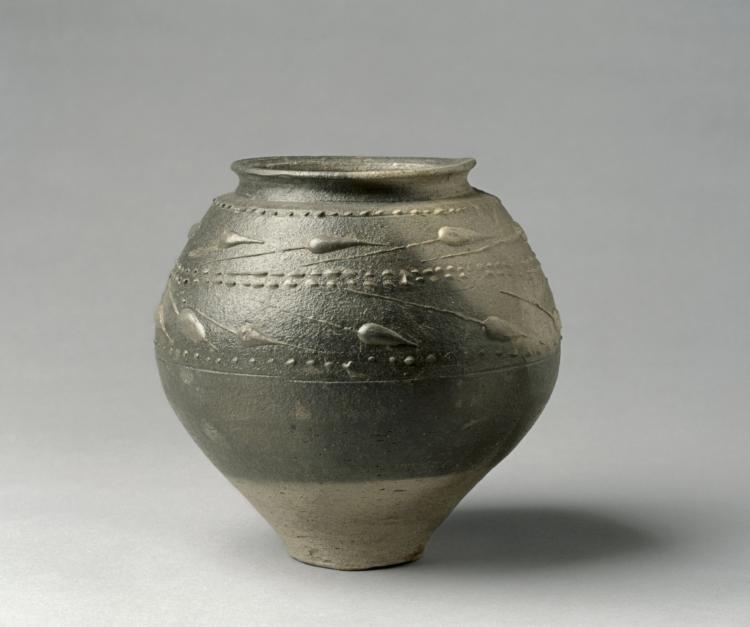
This pot’s decoration was applied using the barbotine method, in which a reed or horn is used to pipe clay slip onto the surface.

Description

This pot is decorated with a pattern of leaves arranged in two rows, separated by parallel lines of dots. The vessel was thrown on a potter’s wheel and covered in a dark slip, leaving about two inches above the foot bare. After the Romans occupied Gaul (modern day France and Belgium) in the 1st century BCE, pots like this one with dark brown or black slips became increasingly popular in the northern provinces of the Roman Empire.
A globular, gray ware vessel tapers to a small, flat base. Dark slip coats its burnished upper half, contrasting with the light, matte gray lower section. Three horizontal bands encircle the middle, featuring raised dots and teardrop shapes with tails trailing left. A short neck flares into a thin rim at the top. Fine, horizontal striations mark the surface, where the dark slip overlaps the lighter gray base.

Globular Pot

25–50 CE

Rhenish (Cologne), Gallo-Roman, 2nd quarter 1st Century

See Also

Visually Similar by AI

    Contact Us

    The information about this object, including provenance, may not be currently accurate. If you notice a mistake or have additional information about this object, please fill out the appropriate request form linked below:

    Update or Correct Artwork Information

    Imagery or Rights for Non-Open-Access Artworks

    Report a Website Issue

    Further Questions About This Artwork