Acquiring “Cleveland Quality”
- Magazine Article
- Collection
How Do Artworks Enter the Collection?
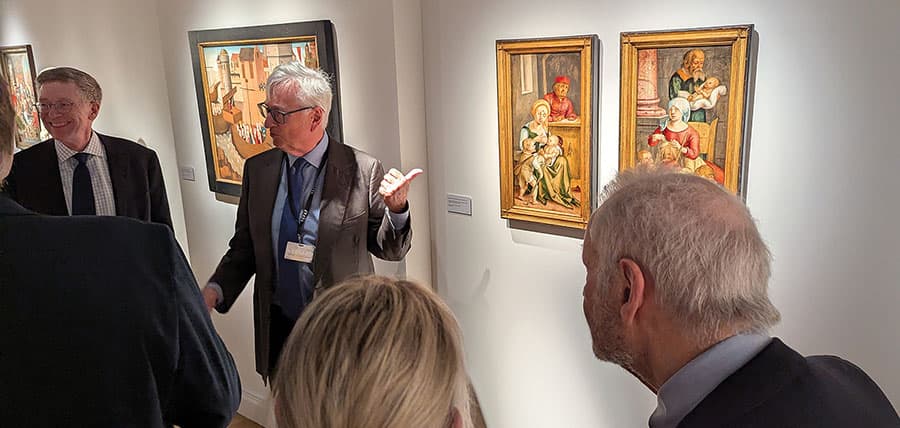
CMA director William M. Griswold and art dealer Sam Fogg at TEFAF Maastricht in March 2026 discussing with CMA staff and supporters two paintings by German artist Hans Süss von Kulmbach that were subsequently acquired by the museum
The extraordinary collection of the Cleveland Museum of Art has been built over more than a century through the judicious choices of the museum’s curators, directors, and donors. Its artworks—spanning more than 6,000 years and many of the world’s cultures—are noted for their excellence, and in many cases, their rarity. Indeed, the phrase “Cleveland quality” is known throughout the art world as emblematic of the collection: Collectors, dealers, and museum professionals understand that it comprises objects of the highest quality and that truly exemplify an artist’s work, or a particular period, style, or culture.
Currently there are about 68,000 artworks in the collection; by contrast, the Metropolitan Museum of Art has more than 1.5 million, and the National Gallery of Art has nearly 160,000. Yet, while the collection is smaller than that of other major museums, the CMA’s emphasis on excellence and on the acquisition of works that are valued by scholars and connoisseurs—but that are also accessible and of interest to the general public—has ensured that its collection is considered among the finest anywhere in the world.
Visitors who enjoy learning about the museum’s works both in person and online may wonder about the process by which they enter the collection: How do staff decide what to acquire, and what steps are undertaken from the moment a work is first considered to its appearance in a gallery?
Typically, an acquisition begins with an idea of one of the museum’s 20 curators—an artist whose work they would like to pursue, or a type of object not yet represented in the collection—or through contact made to a curator by a potential donor or art dealer. Works are also pursued at auction. Given the quick turnaround time of these, it is helpful for curators to have existing relationships with auction house specialists, who can advise as far in advance as possible of upcoming lots of interest. The CMA’s curators also learn of potential acquisitions through participation in art fairs and by visiting galleries. Forming relationships with dealers, as with auction house personnel, is important, as curators may be informed about particular objects of interest before others are—perhaps works newly on the market from a private collector—if the curator has communicated in advance to the dealer about the types of works the museum is seeking.
Relationships are key, and just as curators get to know art world specialists, they also get to know potential donors, discussing with them the types of works that would benefit the collection. Collectors may contribute through both gifts and purchases of their works. Dealers, too, may make donations. As an example, the CMA hosts a wonderful Print Fair each April, in conjunction with the Print Club of Cleveland, and the museum has benefited from the largesse of participating print dealers who kindly donated works to the museum, even as the museum also makes strategic purchases there.
Most regularly, the collection expands through gifts from generous donors, or through purchases. Gifts themselves come in many forms: a donation of a work that has been in a family for generations; a work specifically purchased by a donor for the museum, usually through conversations with museum staff; or part-gift, part-purchase agreements, where the museum contributes to the acquisition with funding while some of the work’s value is recognized as a gift.
Over and above curators’ and the director’s efforts in this process, the museum’s trustees—as well as its specialists in philanthropy, collections management, conservation, and the Ingalls Library and Museum Archives—have important roles to play. Artworks under consideration are typically sent to the museum to be examined by our conservators, with registrars overseeing the effort that goes into properly packing, insuring, and shipping them around the world. Curators undertake research using the extraordinary resources of the Ingalls Library and Museum Archives, making presentations of potential acquisitions to the director and their curatorial colleagues four times each year.

If approval is given to move forward, more research takes place and a formal written proposal is prepared, detailing the object’s history, context, provenance, and other considerations. Just as proper, well-documented provenance is crucial, price is a key consideration. The museum would not make a purchase if the price is not commensurate with the item’s importance. Once all the documentation is in order, the curator presents the artwork to the museum’s trustees at a meeting of the Collections Committee. There, once each season, board members vote to approve acquisitions by purchase and gift. Shortly after those meetings, visitors to the museum, and those who explore the collection online, can see new acquisitions on view.
The CMA’s attention to relationships, research, and a rigorous process around acquisitions ensures that “Cleveland quality” is maintained throughout generations. The museum’s exceptional collection—held in trust “for the benefit of all the people forever”—is truly a gift that keeps giving, today and for decades to come.