Manet & Morisot
- Magazine Article
- Exhibitions
An Artistic Friendship
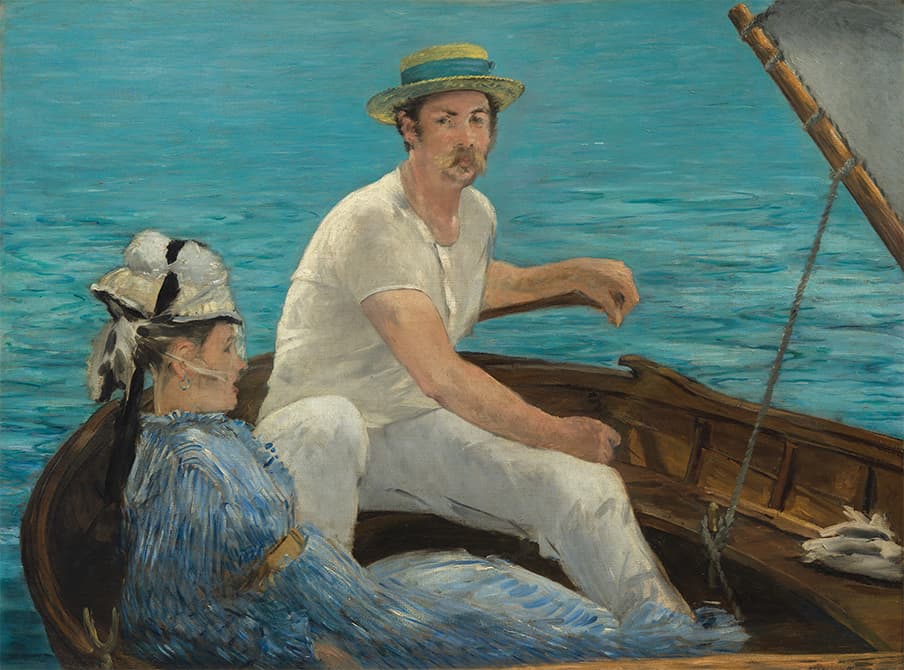
Boating, 1874–76. Édouard Manet (French, 1832–1883). Oil on canvas; 97.2 x 130.2 cm. The Metropolitan Museum of Art, New York, H. O. Havemeyer Collection, Bequest of Mrs. H. O. Havemeyer, 1929, 29.100.115
Manet & Morisot is the first major exhibition dedicated to the artistic exchange between Édouard Manet, considered the father of modern painting, and Berthe Morisot, the only woman among the founding members of the Impressionist movement. Thirty-six paintings and seven works on paper on loan from museums and private collections in the United States and Europe reveal the artists’ singular friendship as it evolved from their meeting in the late 1860s until Manet’s death in 1883. Manet and Morisot were friends and colleagues, painter and model, collectors of one another’s works, and, following Morisot’s marriage to Manet’s brother, Eugène, family. At times, their relationship was collaborative and competitive, playful and charged, but it was always grounded in mutual sympathy, respect, and a shared desire to make art new.
In the past, when considering the relationship between the two artists, critics focused on the 10 portraits Manet made of Morisot between 1868 and 1874, or dismissed Morisot as a mere “student” of Manet. While Manet’s portraits of Morisot are indeed beguiling, and she did look to him for inspiration and approval early in her career, by the mid-1870s, Manet had begun to follow Morisot’s example, emulating her choice of subjects, brilliant colors, and rapid, fluttering brushstrokes. This exhibition explores the complexities of their relationship and examines the ways in which they influenced one another while maintaining their individuality and unique styles.
A comparison of two paintings helps illuminate the parallels—and differences—between the artists. When looking at their work, it is important to keep in mind that Manet painted in his studio, producing pictures that he hoped would look dashed off in one session but that in fact were created with extensive revisions. In contrast, Morisot was trained as a landscape painter and was skilled at working swiftly and decisively outdoors and under changing conditions of weather and light.
Manet began painting the ambitiously scaled Boating during a visit to the riverside town of Argenteuil in 1874. But he struggled and continued revising it for years before first revealing it to the public in a small exhibition in his studio in 1876. He later exhibited it in 1879 at the Salon, the official, annual juried art exhibition of the French Academy of Fine Arts in Paris. In the painting, a stylish couple sits in the stern of a sailboat. The man holds the tiller and looks directly at the viewer. His companion reclines in profile, gazing beyond the confines of the composition. Small swirls form in the boat’s wake, but the background is essentially a horizonless wall of blue. Manet makes little attempt to suggest the movement of the water or the effect of light. Recent technical examination reveals that the composition began as a single male figure in the vessel. The woman was added later but before the composition was fully realized; most of her body was painted over the interior of the boat, while the top of her face and hat appear to have been painted directly on the white ground. Manet also changed the position of the sail and the rope, which was initially held by the boatman instead of tied.

At first glance, Morisot’s Lake in the Bois de Boulogne (known as Summer’s Day) appears similar to Boating. The compositional elements are the same: an abruptly cropped boat, a central figure who returns our gaze, and a companion in profile at the left. But on closer examination, the effect of Summer’s Day is entirely different. The straw-hatted boatman in Manet’s painting has been replaced by a woman in a pale gray dress and black lace gloves; Morisot seldom depicted men in her paintings. Instead of a blue backdrop of water, she provided a vista of the Bois de Boulogne, a large park on the western edge of Paris, with ducks paddling and sunlight dancing on the surface of the lake. The most radical divergence from Boating is the brushwork Morisot employed in Summer’s Day. Her canvas is covered with zigzags and slashes of paint, one hue layered on top of another, creating movement and sparkle. Morisot embraced sketchiness and evidence of the artist’s hand at work; the idea of a painting appearing “unfinished” did not frighten her. By the mid-1870s, when Manet was laboring over Boating, he was aware of—and full of admiration for—Morisot’s bold, fluttering brushwork. In the blue-and-white striped dress in Boating, he channeled the quick lightness of Morisot’s touch, which she took to another level in Summer’s Day.