Pintoricchio Magnified
- Magazine Article
- Collection
- Conservation
- Digital Innovation
- Exhibitions
An Immersive Conservation Experience
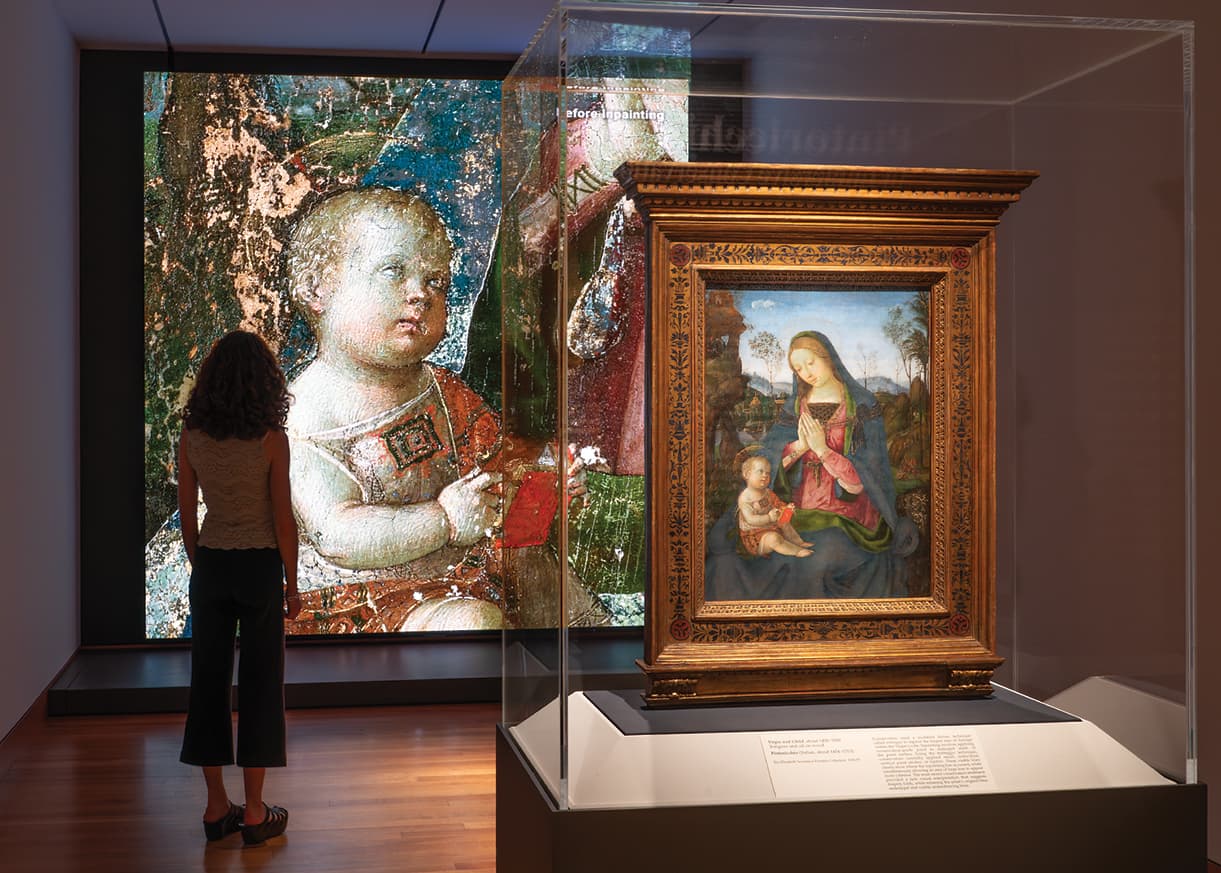
A first-of-its-kind immersive conservation experience offers CMA visitors a chance to go beneath the surface of a painting into its complex art historical background and treatment history. Opened in August, Pintoricchio Magnified: An Immersive Conservation Experience provides an unprecedented digital exploration of the recent multiyear conservation treatment of one of the most damaged paintings in the collection: Pintoricchio’s 15th-century Italian masterpiece Virgin and Child.
In the gallery, the painting has been placed in a central, lit vitrine rather than on a wall. This nontraditional display provides a unique viewing experience, showcasing the back of the painting and frame often hidden from view. The reverse—or verso—of a painting can be as interesting as the front, telling of evolving practices and materials used over the centuries. The painting’s appearance has drastically changed over the years, as conservators and restorers applied different methods to mask areas of damage. When the painting was acquired in 1944, the Virgin wore a brown robe, but by the 1990s, it appeared as dark blue. Recent cutting-edge technology, including novel use of CT scanning at the Cleveland Clinic, and thorough examinations of paintings by the artist in collections around the world have informed the latest treatment, which focused on using remnants of the original paint layer to guide a more ethical and holistic reconstruction.
The large digital screen at the back of the gallery reveals aesthetic decisions made during the conservation process to address the large area of damage within the robe. The Italian technique trattegio was selected for this complex treatment. This method uses reversible, conservation-grade paints applied under magnification to create highly refined, visible paint strokes. This inpainting strategy unifies well-preserved areas with areas of loss, allowing the painting to regain an overall aesthetic balance. Using Pintoricchio’s underpainting as a guide, folds were reconstructed, presenting the imagery closer to how the artist intended it.
The complexity of both the treatment and the conservation research was well suited for a digital interactive, providing an accessible way for visitors to understand how innovative technology and conservation work preserve the museum’s collection. To support visitor understanding of the process, the team developed an immersive experience in the gallery. Led by the digital innovation team in collaboration with the painting conservation lab, the experience invites guests to explore the conservation story interactively. A 10-by-10-foot screen responds to the movement of visitors, allowing them to amplify and study specific areas of the work, as if viewing the painting through a microscope, and physically toggle between technical and treatment imaging layers, following the conservation process step by step.

cleaning with original remnants remaining; the right image shows the painting after conservation
treatment.
The experience is notable for its quiet, ambient quality. Rather than relying on touch screens or fast-paced interaction, it encourages slow looking. Visitors can engage at their own pace; this more meditative approach supports a deeper appreciation for the painting’s materials and structure. Design and development of this interactive platform was supported by Eric Mika, founder of Scalar Studio, whose work focuses on creating responsive digital environments. The system uses computer vision to track visitor movement and adjust content in real time. Its flexible design points toward future applications for responsive experiences across gallery spaces.
Working together, the conservation and digital innovation teams have created an experience that brings visitors closer to both the artwork and the process behind its preservation. Pintoricchio Magnified: An Immersive Conservation Experience shows how collaboration across disciplines can reveal new layers of meaning and connection. The museum remains committed not only to caring for its collection but also to finding creative, accessible ways to share that work and its stories with the public.