Premodern India’s Serial Storytelling
- Magazine Article
- Exhibitions
Paintings from the “Shangri” Ramayana
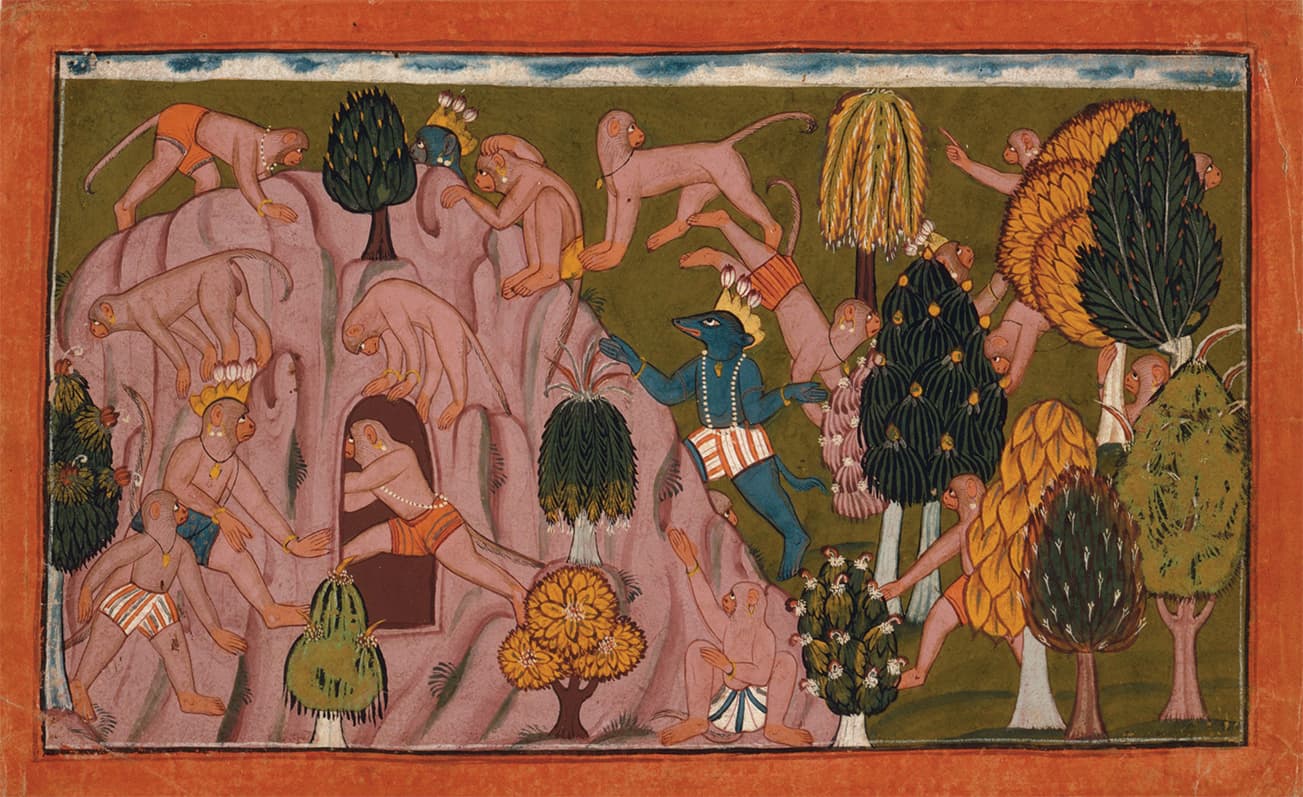
Monkeys and bears search for Sita from the “Shangri” Ramayana, c. 1700. Gum tempera and silver on paper; 21 x 33.7 cm. Los Angeles County Museum of Art, Nasli and Alice Heeramaneck Collection, Museum Associates Purchase, M.74.5.11. Digital image © 2026 Museum Associates / LACMA. Licensed by Art Resource, NY
Most collections of Indian paintings include individual works extracted from a manuscript, album, or pictorial series. On display in a museum or a home, a painting can be savored in an elegant mat and frame, appreciated for its artistry and subject matter. However, when paintings that were made to be part of a series are viewed in their sequential ensemble, they visually communicate the action of a story across multiple pages. They reveal how artists purposefully connect adjacent scenes to create emotional tensions, building up to otherwise unrecognizable climaxes that allow viewers to feel the passage of time.
The exhibition Epic of the Northwest Himalayas: Paintings from the “‘Shangri’ Ramayana” explores serial storytelling in premodern India through the case study of one singular pictorial work produced around 1700. Forty paintings from the “Shangri” Ramayana are on view, drawn from 12 different collections in Canada, Europe, and the US. These 40 works present key moments from nearly the entire sweep of the Ramayana of Valmiki, an epic tale that has remained current in many Hindu contexts for more than 2,000 years. Another 83 paintings from the series, featuring consecutive animated images of three selected episodes, are shown digitally. Visitors can witness the story unfold moment by moment.
In two instances, sequential paintings now kept in different collections are hung side by side to reveal the powerful effect of viewing the “Shangri” Ramayana scenes serially. In one sequence, monkeys and bears help the hero Rama search for his wife, Sita, who has disappeared in the forest. They search the mountains, caves, and woods, with gusto at first, but eventually they become exhausted. One monkey sits down and motions for others to continue looking. A bear gestures in exasperation; another monkey scratches his head in wonderment. In the next painting, the forest has grown denser, more impenetrable, and appears to all but consume the seekers as they push themselves to keep looking. Sita is nowhere to be found. On the left, birds foreshadow an adventure to come.

Reassembling the sequential pages of the “Shangri” Ramayana has resulted in unexpected insights. It consists of far more paintings than once realized. Previous publications identify about 270 pages as belonging to the series. Research for this exhibition, however, has located a total of about 640 paintings and suggests that close to 1,000 were made. Multiple artists from several different workshops situated throughout the Pahari region of the northwest Himalayas helped complete this monumental project for a patron who remains unknown.
Today, paintings from the “Shangri” Ramayana are dispersed among dozens of collections worldwide. The division of this series, made without text pages and never bound, began at least by the third quarter of the 1700s. Since the creation of a Ramayana—a story that is sacred to most Hindus—was a devotional act, and paintings were considered objects of wealth like fine textiles or jewelry, its paintings historically functioned both as objects of religious merit and as financial assets to be shared with others through the process of gift giving and dowry. By the 1930s, art enthusiasts outside of Pahari royal family circles began to add paintings from the “Shangri” Ramayana to their collections. Catherine Glynn Benkaim and her late husband, Ralph Benkaim, acquired three of them for their comprehensive Pahari painting collection, the catalogue of which is published by the Cleveland Museum of Art, entitled Pahari Paintings: Art and Stories (2026). The exhibition Epic of the Northwest Himalayas re-emplaces the three “Shangri” Ramayana pages from the Benkaim Collection into the context of this remarkable series as a whole.