Rethinking an American Artist
- Magazine Article
- Exhibitions
Andrew Wyeth’s Spectacular Watercolors
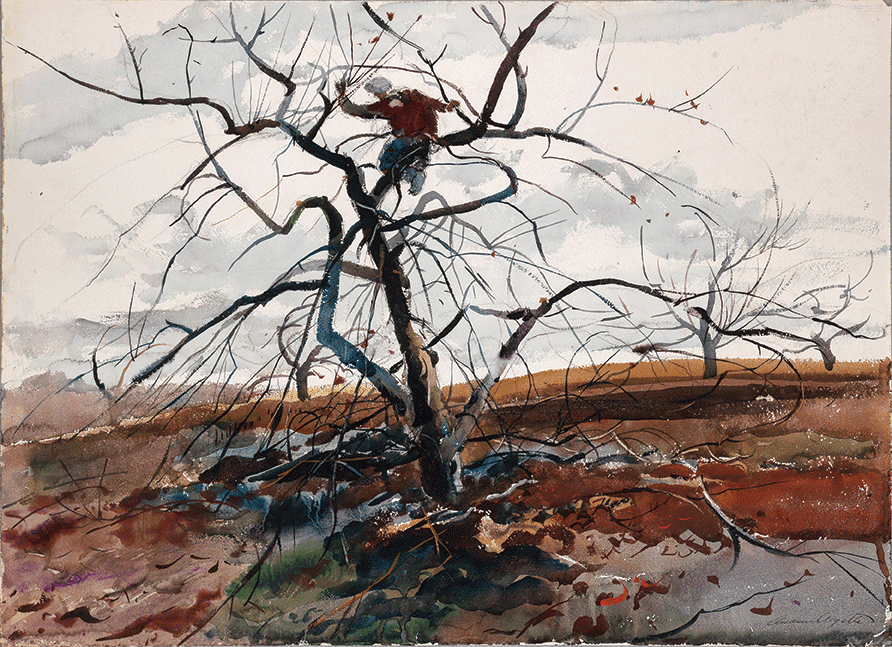
Pruning, Study for Spring Pruning, 1937. Andrew Wyeth (American, 1917–2009). Watercolor on paper; 54.6 x 74.9 cm. Wyeth Foundation for American Art Collection, P0105. © 2026 Wyeth Foundation for American Art / Artists Rights Society (ARS), New York
Perhaps surprisingly, it was watercolor that officially launched the career of Andrew Wyeth (American, 1917–2009)—an artist better known for his tempera paintings. In 1937, the young artist—not yet 20 years old—traveled to New York City to show a selection of his works to the storied dealer of American art Robert Macbeth. Within months, a solo exhibition of his watercolors drew collectors and critics from far and wide, with one writer praising the work for its “spectacular freedom.” Spectacular Freedom: Andrew Wyeth and the Modern American Watercolor is the first exhibition to offer an in-depth exploration of the iconic American artist’s work in the medium, examining this practice throughout the early decades of his career. Beginning in the 1930s, Wyeth gained celebrity status for his use of watercolor and for depicting familiar subjects in expressive and evocative compositions.

Despite the key role that watercolor played within Wyeth’s practice, the medium has received comparatively little attention, as he gradually became better known for precise and often poignant paintings using tempera paint. While he worked slowly in that medium, he created prolifically and constantly with watercolor. Wyeth used watercolor throughout his long career, making finished works, preliminary studies, memory aids, and completely abstract compositions until his death nearly a century later.
As Spectacular Freedom reveals, watercolor was the ideal medium for Wyeth to depict—often from surprising or unusual perspectives—the people and places that surrounded him in rural Pennsylvania and Maine. For example, Maine Fisherman, created in 1936, monumentalizes a scene in which a man bends, using his weight to pull a lobster trap from the ocean’s choppy waters. Light falls directly on the fisherman through gray, gathered clouds, and his small fishing boat is seen from a close-up view that allows it to take up most of the sheet.

Because Wyeth spent summers in Maine and winters in Pennsylvania, his works created in the two locales have vastly different palettes, featuring the colors that define their respective seasons. Like Maine Fisherman, Pruning shows a worker whose labor defined the local landscape—this time, outside Chadds Ford, near Philadelphia, where Wyeth lived and worked. In this watercolor from 1937, a massive, leafless tree fills the space in the midst of an expansive brown field. Dormant colors are broken up by the deep red jacket of a man atop one of the highest branches, reaching upward with pruning shears while delicately balancing himself.
The works on view in the exhibition draw attention, in a new way, to the ongoing dialogue between watercolor and tempera throughout Wyeth’s work. Before ever beginning a painting, the artist considered every aspect through watercolor, often recording individual figures in isolation, testing the overall palette of the work, and even thinking and rethinking the way the image itself would look. Perhaps less expectedly, though, Wyeth would often record aspects of his favorite subjects that struck him in the moment, returning to them, sometimes even years later, as source material for paintings. In the Church Yard, a 1934 watercolor, is among Wyeth’s earliest works to feature Mother Archie’s Church near his studio in Chadds Ford. The African Union Methodist Protestant church, which served as an important gathering place for the local Black community, recurred frequently throughout Wyeth’s work in the following decades. A painting created three years later titled Fall at Archies, for instance, features a similarly lush view of the churchyard and the building, whose congregants Wyeth befriended during his time in Pennsylvania.

Beyond offering such new perspectives on Wyeth’s watercolors, Spectacular Freedom also provides the opportunity to view works by the artist that have never before been seen by the public. A first-of-its-kind collaboration, this exhibition features watercolors selected from the Wyeth Foundation for American Art Collection. These holdings consist of works that were kept by the artist and his creative partner and wife, Betsy, throughout their lives. Because of their shared preference to exhibit works that were considered completely finished during Wyeth’s lifetime, many of the artist’s watercolors have thus far not been displayed publicly. Since the couple’s death, the collection has remained in the Wyeth Study Center at the Brandywine Museum of Art in Chadds Ford, Pennsylvania, and the Farnsworth Art Museum in Rockland, Maine. The nearly 75 watercolors and select tempera paintings on special loan from this collection highlight a little known but major aspect of Wyeth’s life and art, while revealing fundamental questions about the place of watercolor in the art world of his time.