Revitalizing the “Court of Nature”
- Magazine Article
- Building and Grounds
- Conservation
The Conservation of the Zodiac Garden and Fountain of the Waters
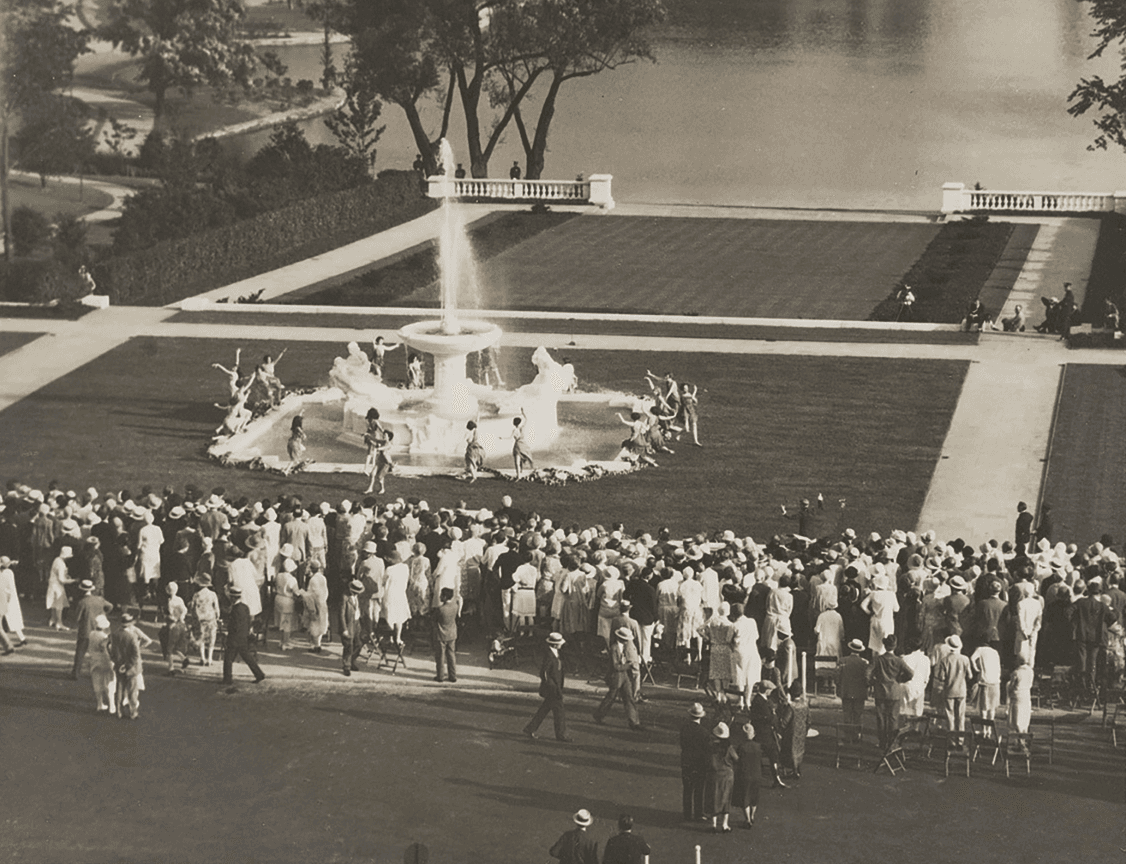
Sculptor Chester A. Beach’s sparkling Fountain of the Waters was the centerpiece of the dedication ceremony for the Fine Arts Garden on July 23, 1928.
In 1925, the parcel of land south of the Cleveland Museum of Art was described as an eyesore: a muddy, bare city park left neglected after the construction of the museum was completed. Just three years later, in July 1928, a dedication celebration of the new Fine Arts Garden was held, complete with dancers, music, flowers, and the sparkling waters of a gleaming marble fountain. The remarkable transformation was spearheaded by the Garden Club of Cleveland, led by Frances McIntosh Sherwin and Alice King Howell, who gathered their influential contemporaries to raise funds and convince city and museum leaders to support the creation of a garden park between the museum and Euclid Avenue.
By September 1925, Sherwin had obtained a design proposal from landscape architect Frederick Law Olmsted Jr. for a garden with formal terraces at the north and south ends, connected by winding paths and natural areas encircling an enlarged lagoon. A program of sculpture in marble and bronze developed along with the landscape plans, conceived as an integral and fitting part of the beautification of the property surrounding the city’s cherished art museum. Within the formal parterre at the south end, closest to the museum, Olmsted proposed a water feature. By the end of 1926, Howell had enlisted New York–based sculptor Chester A. Beach to design a marble fountain for this spot.
Beach soon expanded his plans into a unified, allegorical sculptural scheme he called the “Court of Nature.” Drawing inspiration from the natural setting along Doan Brook, he designed figures representing the waterways flowing out of Lake Erie, which is signified through the main basin, added two bronze sculptures to the east and west symbolizing the earth and the sun, and framed the entire ensemble with the stars of the heavens, in the form of 12 marble pillars with signs of the zodiac, giving the Zodiac Garden its current name.
In the century since, Beach’s marble sculptures have been impacted by wind, snow, and rain of 100 Cleveland winters, compounded by atmospheric pollution, algae and lichens, and impurities in the city’s water supply. These forces, both natural and man-made, have resulted in darkening, weathering, and structural instability in the stone sculptures and in Olmsted’s meticulously designed pathways, stairs, and curbs.
Today, the Zodiac Garden is poised for another exciting transformation. Museum and city leaders are collaborating with partners in landscape design, construction, and conservation on a comprehensive plan for the garden’s revitalization. The stone elements of the fountain and the zodiac pillars are temporarily moved off-site for extensive conservation treatment, and the fountain receives a new concrete foundation, updated plumbing to reduce water use, and new lighting. The historical walkways and stonework are restored, retaining as much of the original material as possible. Together, these efforts ensures that the Zodiac Garden continues to be a welcoming setting for Clevelanders and community celebrations for another century.