Still, Yet Moving
- Magazine Article
- Exhibitions
Ann Hamilton and Photography
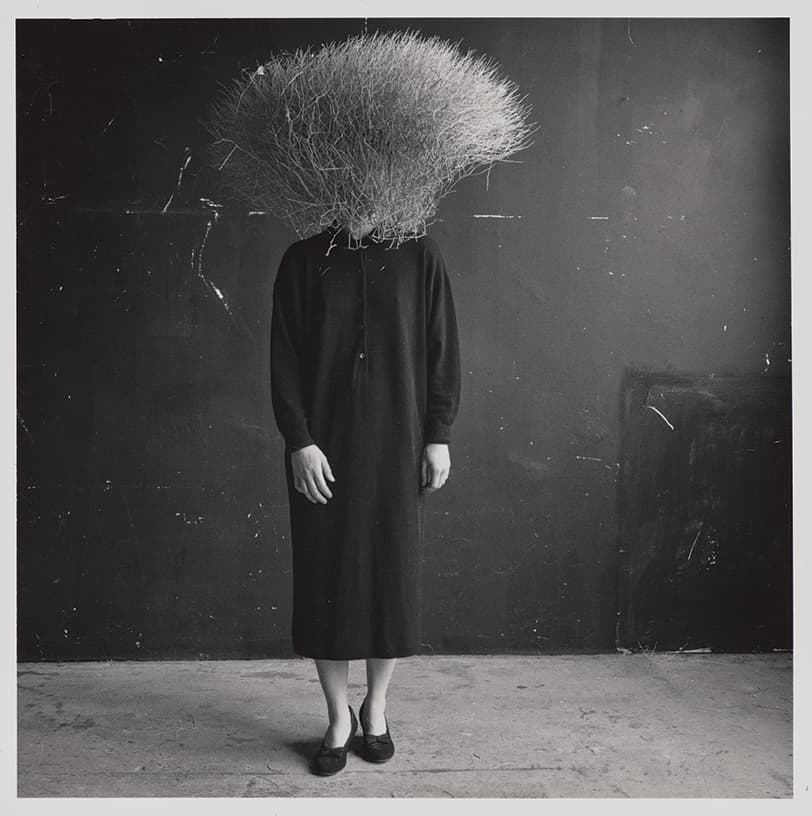
body object series #5 • sagebrush, 1986–88. Ann Hamilton (American, b. 1956). Gelatin silver print; 9.9 x 9.9 cm. The Cleveland Museum of Art, The Severance and Greta Millikin Purchase Fund, 2019.237. © Ann Hamilton
Where am I? What is here? Who is here? These are the questions that artist Ann Hamilton asks herself at the beginning of every project. Each undertaking is a quest to find the appropriate media, form, image, and physical manifestation for a particular site or occasion. Eight years in the making, Hamilton’s exhibition at the Cleveland Museum of Art focuses on a medium that has become over the past decade, as she describes it, “a central spine” within her practice—photography.
Hamilton’s illustrious 40-year career has included numerous important large-scale ephemeral installations, performances, and public artworks. Less widely known is the Columbus-based artist’s consistent, but nontraditional, use of photographic media. One wall in the exhibition surveys that history, starting with her first photographic project, the body object series from the mid-1980s. Hamilton wears and holds objects that were assembled for one of her installations. By joining these items to her body, she changes their function and psychological relation, resulting in unsettling scenes with underlying wit. Over the intervening decades, Hamilton has experimented with pinhole photography, photographing people through a thin membrane, video, and scanning. The latter is the process she has used to create a monumental installation for the CMA.
Here, Hamilton has employed scanning to bring the public’s attention to objects in the museum’s collection that are rarely on display: small-scale figurative ceramics and crèche figures from the 17th to 19th centuries. The complex, twisting shapes of these sculptures came to life when a wand (handheld) scanner was used to depict them. Touch was integral to this visual process. To work, the wand had to have physical contact with a surface, so Hamilton rolled it over a thin sheet of plastic that she had placed over or around the sculptures. Moving the wand, the sculptures, or both, Hamilton drew with lens and light, a reminder that the scanner is a photographic medium.
Touch was integral to this visual process. To work, the wand had to have physical contact with a surface, so Hamilton rolled it over a thin sheet of plastic that she placed over or around the sculptures. Moving the wand, the sculptures, or both, Hamilton drew with lens and light, a reminder that the scanner is a photographic medium.

Time is also an inherent component of scanning. A traditional still photograph captures a single moment, but a scan requires movement over an extended interval. If the goal is expression rather than replication, that movement can become a dance between object and scanner, a tango that creates distortion. Hamilton’s blurred images suggest the capture of a gesture, the register of a glance. In this way, she imparts a sense of animation and of the passage of time to these figures who have been frozen in form and space.
Hamilton’s floor-to-ceiling images of the diminutive sculptures fill the walls and surround the viewer in the Mark Schwartz and Bettina Katz Photography Galleries. The sculptures become characters joined in a story that is hinted at but never told. Sound that is neither dialogue nor music emanates from two horn-shaped rotating speakers.
A different photographic medium—video—dominates the second of the exhibition’s two galleries. Three videos circle the walls, their content asking us to consider the act of making, to explore the concept of turning in space, and to ponder the relationship between touch and language. The projectors are enclosed within Plexiglas boxes so that each video is refracted, doubled, and mirrored as it spins: The primary image moving around the room both trails and is chased by its own reflection.
No matter the medium, Hamilton’s artworks share with poetry an affinity for elision, evocation, allusion, and association. They pose questions rather than answer them.