Still/emerging
- Magazine Article
- Exhibitions
Native American Works on Paper
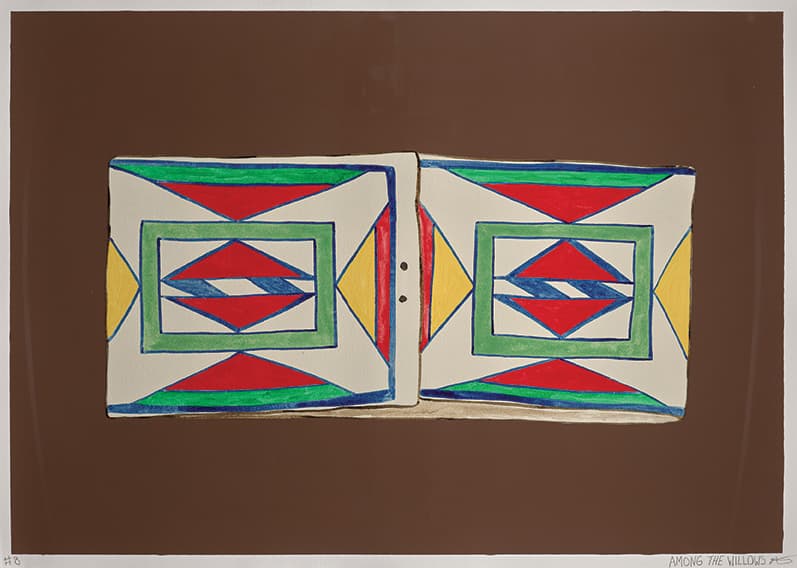
Bischkisché: Among the Willows, 2023. Wendy Red Star (Apsáalooke/Crow, b. 1981). Acrylic and graphite on kitakata paper and coated pastel paper; 50 x 70.1 cm. Norman O. Stone and Ella A. Stone Memorial Fund, 2024.170.1. © Wendy Red Star, courtesy of the artist and Roberts Projects, Los Angeles
still/emerging: Native American Works on Paper is the first exhibition to highlight the Cleveland Museum of Art’s collection of prints and drawings by Native American artists. In 2022, the creation of the museum’s Indigenous Peoples and Land Acknowledgment inspired a commitment to greatly strengthen the museum’s holdings in this important field. The title of the show comes from a poem by Diné (Navajo) poet Kinsale Drake on Indigenous survivance, a term that describes how Native people have survived and resisted colonialism in the United States. It also references the fact that the CMA land acknowledgment serves “not as an end but rather as the beginning” of an ongoing collaboration with our Native community members. The objects on view survey the ways in which Native artists have innovatively used printmaking and drawing techniques to explore their cultural heritage. This exhibition includes more than 50 works created from the 1950s through today that showcase the unique histories and perspectives of Indigenous artists from a number of backgrounds and tribal affiliations.

Featured in the exhibition is a recently acquired series of powerful woodcut portraits by T. C. Cannon (Kiowa-Caddo, 1946–1978), who grew up in Zodaltone and Gracemont, Oklahoma. He was a member of the Kiowa Tribe and also had Caddo and French ancestry. In 1964, he enrolled in the Institute of American Indian Arts in Santa Fe, New Mexico, where he studied with the Native American painter Fritz Scholder. After graduating, he went to the San Francisco Art Institute but left after two months to enlist in the army, where he spent two years serving as a paratrooper stationed in Vietnam. He returned to Santa Fe in 1969 with renewed vigor for his art, refining his distinct portraits of Native subjects infused with a bright color palette and drawing from a Pop aesthetic, effectively combining both traditional and contemporary aesthetic traditions. Cannon’s promising career was tragically cut short in May 1978, when he died at age 31 in a car accident outside of Santa Fe, only a few months ahead of his first major one-person exhibition at the Auerbach Gallery in New York.
Cannon’s Memorial Woodcut Suite gives an overview of the artist’s unique visual vocabulary and investigations into the nuance and complexity of Indigenous identity. Each print is based on a major painting in the artist’s oeuvre. A common theme is portraits of imagined, stoic warriors wearing combinations of traditional tribal clothing and accoutrements, as in His Hair Flows Like a River. Dots in the background allude to the hallucinations experienced during a sun dance, an annual religious ceremony traditionally held before summer bison hunts by tribes in the Great Plains. The images of warriors also reflect Cannon’s own conflicting feelings about having served in the US Army to defend a country that ultimately subjected his people to genocide and forced removal from their ancestral homelands.
Other works in the exhibition include a set of deeply symbolic color lithographs by Jaune Quick-to-See Smith (Citizen of the Confederated Salish and Kootenai Nation, 1940–2025) and monoprints by Edgar Heap of Birds (Cheyenne and Arapaho Nations, born 1954). The presentation also features works by multimedia artists, such as Wendy Red Star (Apsáalooke/Crow, born 1981), Kay WalkingStick (American, Member of the Cherokee Nation/Oklahoma, born 1935), Nicholas Galanin (Tlingít/Unangax̂, born 1979), and Rose B. Simpson (Santa Clara Pueblo, born 1983), which shed new light on the importance of the graphic arts within their contemporary practices. Community voice labels by members of the museum’s Native American Advisory Committee, who have been involved in the museum’s efforts, highlight the local impact of this growing collection at the CMA.