The Cleveland Museum of Art
Collection Online as of May 6, 2024
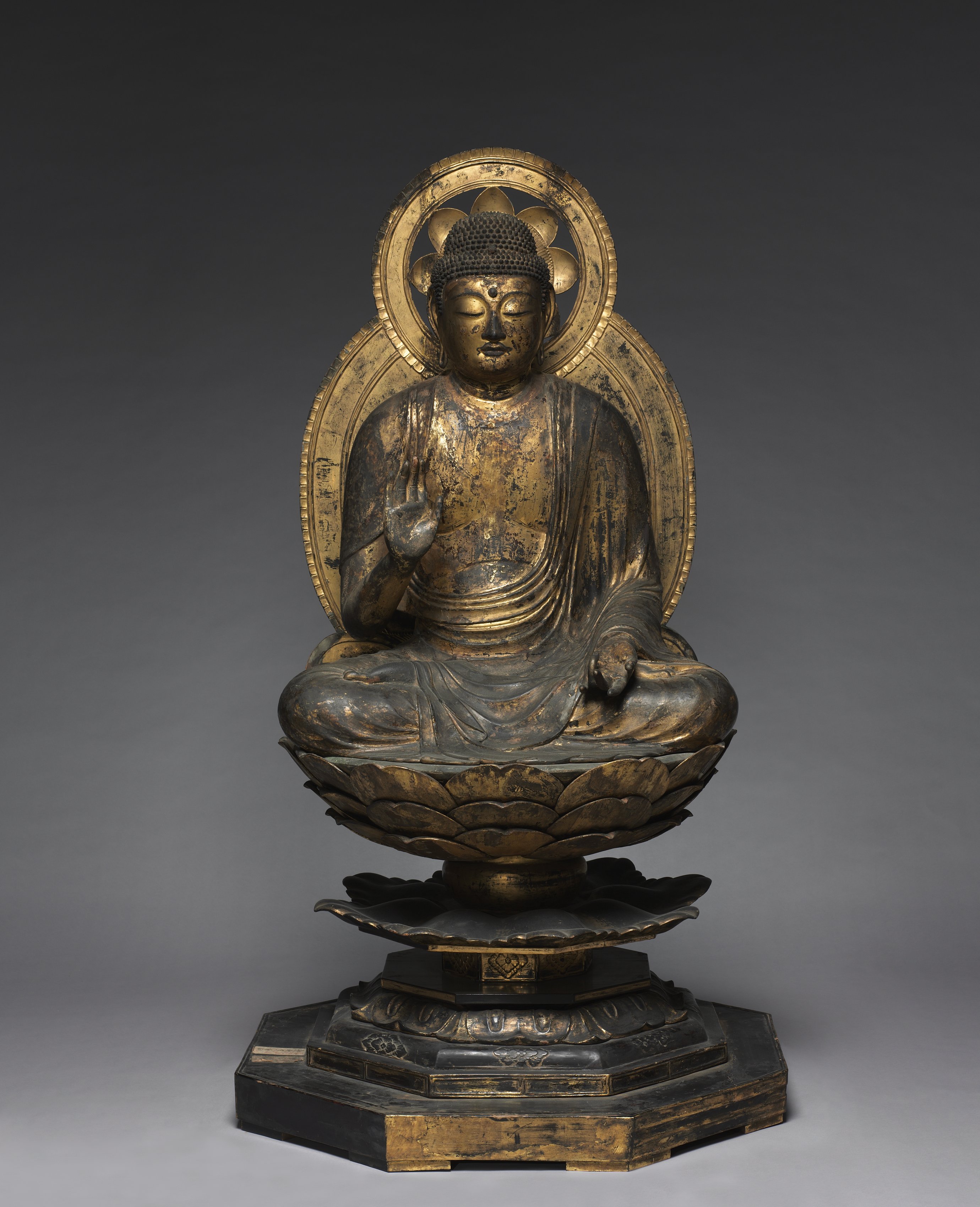
Seated Buddha with Halo
1100s
(794–1185)
Overall: 145.4 cm (57 1/4 in.); Figure: 88.2 cm (34 3/4 in.); Pedestal: 57.2 cm (22 1/2 in.)
Location: 235B Japanese
Did You Know?
A 1906 photo taken at Kōfukuji shows this sculpture without a halo or left hand.Description
Composed of a number of hollowed-out pieces of wood that were then covered with lacquer and gilding, this sculpture served as an image of worship in one of the small temples surrounding Kōfukuji, a major Buddhist temple in Nara, Japan. Like many Buddhas, this figure has its right hand positioned in a gesture meaning "fear not." The left hand is a replacement, so its original gesture, a clue to this Buddha's identity, is unknown. However, as the left foot is exposed over the garment, in lotus position, it may have been created as a Medicine Master Buddha, Yakushi Nyorai in Japanese, or the Buddha of our era, Shakyamuni.- ?–1973Setsu Takako 瀬津 孝子, Tokyo, Japan, given to the Cleveland Museum of Art1973–The Cleveland Museum of Art, Cleveland, OH
- Tōkyō Bijutsushō Kyōdō Kumiai 東京美術商協同組合. Kobijutsu tenkan tokubetsu sokubaikai: Orinpikku kinen [古美術展観特別即売会 : オリンピック記念 = Antique dealers' fair & exhibition in Tokyo: on the occasion of the Olympic Games]. Tōkyō: Tōkyō Bijutsushō Kyōdō Kumiai, 1964.“The Year in Review for 1973.” The Bulletin of the Cleveland Museum of Art, vol. 61, no. 2, 1974, pp. 31–78. Mentioned: no. 196, p. 79; Reproduced: no. 196, p. 69 25152513Yamane, Yūzō 山根有三, Shūjirō Shimada 島田修二郎, and Terukazu Akiyama 秋山光和. Zaigai Nihon no shihō [在外日本の至宝 = Japanese Art: Selections from Western Collections, vol. 8 ]. Tōkyō: Mainichi Shinbunsha, 1979. Mentioned and Reproduced: no. 8, p. 118, pl. 8Shimizu Zenzō, "Japanese Sculptures in America and Canada," Bukkyō geijutsu [佛教藝術= Ars Buddhica] , no. 126 (September 1979), part I, pp. 67-88. fig. 4Yamaguchi Ryūsuke 山口隆介 and Miyazaki Motoko 宮崎幹子, 「明治時代の興福寺における仏像の移動と現在地についてー興福寺所蔵の古写真をもちいた史料学的研究」 (The Transfer of Buddhist Sculptures from Kōfukuji in the Meiji Era and Their Locations Today: Source-study Research Conducted Using Old Photographs at Kōfukuji), Museum, no. 676 (October 2018), pp. ii-iii, 5-57. fig. 13.
- Japanese Gallery 235 Rotation - July 2017-January 2018. The Cleveland Museum of Art (organizer) (July 15, 2017-January 2, 2018).Kobijutsu tenkan tokubetsu sokubaikai: Orinpikku kinen [古美術展観特別即売会 : オリンピック記念 = Antique dealers' fair & exhibition in Tokyo: on the occasion of the Olympic Games]. Tōkyō Bijutsu Kurabu, Tōkyō, Japan (October 8-12, 1964).
- {{cite web|title=Seated Buddha with Halo|url=false|author=|year=1100s|access-date=06 May 2024|publisher=Cleveland Museum of Art}}
Source URL:
https://www.clevelandart.org/art/1973.85