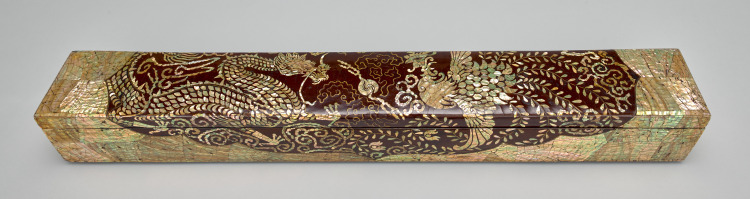
Scroll Box with Dragon and Phoenix Design
Korean Lacquerware and "Things Oriental"
With the advent of serious trade between East Asia and Europe during the 16th century, lacquer as a durable and attractive medium for furniture panels and other related interior surfaces came into high demand among sophisticated European households. By the late 19th century, a taste for "things Oriental" became fashionable in dress, architecture, interior design, and art collecting. Japanese studios feverishly filled orders for European merchants whose clients had seen lacquerwares displayed in the homes of friends or acquaintances; exhibited at the international expositions in Vienna (1873), Philadelphia (1876), or Paris (1900); or highlighted in popular magazine articles.
At that time, Japan and China provided the materials and skilled labor for production and consequently became most closely identified in the West with lacquerware as a commodity and as an art form. Korea was less well-known as an important center of lacquerware production, although it had been fashioning wares since the Three Kingdoms period (37 BC-AD 668). Unfortunately, only a relatively small number of Korean lacquerwares made prior to the 17th century have survived. Of these the largest number can be found in collections in Japan, where Korean lacquer has long been treasured. However, 18th- and 19th-century lacquerwares have enjoyed a more felicitous fate thanks in large part to Korea's vigorous defense against territorial incursions by China and Japan during those centuries. Consequently, the demand for later Korean lacquerware was largely domestic.
19th-Century Scroll Box
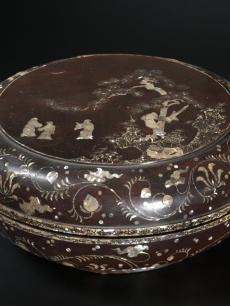
Instead of painted or plain ware, the Joseon-period court (1392-1910) and its related aristocratic families particularly favored inlaid mother-of-pearl lacquer, as can be seen in this covered box. In the 19th century, when this piece was likely fabricated, the inlaid designs tended toward bold, declarative forms. To help achieve such visual effects, craftsmen utilized pieces of shell (nacre) considerably larger in size than those employed in the preceding Goryeo era (AD 918-1392). The central panel of the box demonstrates this technique with its portrayal of a dragon and phoenix facing one another amidst clouds.
The design is centrally composed, emanating outward from the flaming pearl, which is surrounded by linear cloud patterns rendered in twisted metal wires and embedded into the lacquer like the pieces of nacre. The image slides over the rounded edges of the box cover, down onto the lateral flanks of the box body. Here also brass or copper wire-tightly turned to simulate braiding when it is sunk into the brown lacquer surface-provides a defining compositional motif: it separates the illustrated panel from the glistening mother-of-pearl panels covering the remainder of the box cover and body (except for the bottom). This same material and technique, unique to East Asian lacquer art, also gives structural identity to the dragon's body and the phoenix's spreading feather clusters. Notice the artist's efforts to vary wire texture, linearity, and twist density, adding pictorial and decorative variety to the illustration. Similar attentiveness was given to the size, orientation, iridescence, and crackalure surface pattern of the mother-of-pearl inlay, each different from the other.
The dragon and phoenix imagery is unknown among Joseon lacquerware, though it does appear in blue and white porcelai