The Cleveland Museum of Art Hosts the 2026 Cleveland Silent Film Festival and Colloquium
- Press Release
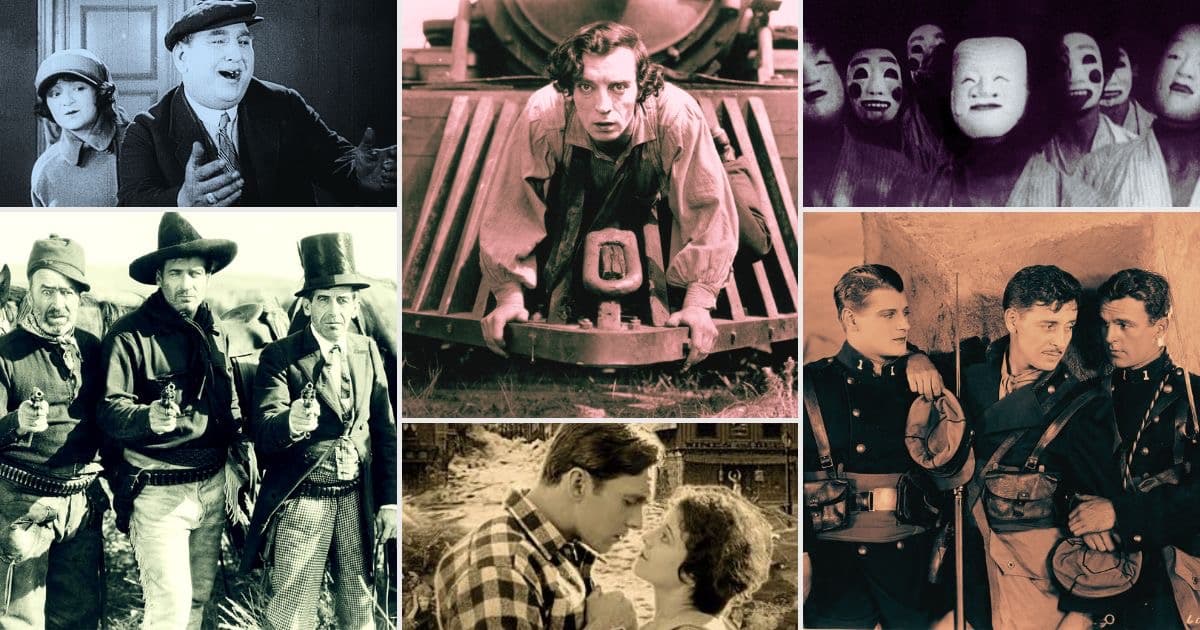
Image courtesy of the Cleveland Silent Film Festival
Contact the Museum's Media Relations Team:
(216) 707-2261
marketingandcommunications@clevelandart.org
Films are Presented on the Big Screen with Live Music for an Unforgettable Experience
Cleveland (August 13, 2026)—The Cleveland Museum of Art (CMA) welcomes the return of the Cleveland Silent Film Festival and Colloquium (CSFF) to Gartner Auditorium this September for four days to celebrate the expressive power of early cinema. Each year, a carefully curated selection of silent films is paired with live musical accompaniment by renowned specialists creating unforgettable cinematic experiences.
“The Silent Film Festival gives audiences a rare opportunity to see these films on a large screen with local and nationally based musicians playing exceptional music,” said Gabe Pollack, director of performing arts. “This year’s film selections have something for every type of film lover. We invite you to join us for your favorite or all four.”
Guests have the option to purchase tickets to individual screenings or to buy a festival pass, which allows purchasers to attend all screenings at the CMA at a discounted fee. In addition, the festival pass includes admission to the screening of East and West on September 15 at 7:30 p.m. at the Cleveland Institute of Art Cinematheque and The General on September 17 at 7:30 p.m. at the Cleveland Grays Armory Museum. Festival pass holders must bring their festival pass to the Cinematheque box office to receive their ticket for the East and West screening and to the Cleveland Grays Armory Museum to receive their ticket for The General screening.
A festival pass costs $120 for nonmembers and $100 for members.
3 Bad Men (1926)
Wednesday, September 16, 2026, 7:00–9:00 p.m.
Gartner Auditorium, Suzanne and Paul Westlake Performing Arts Center
The Western and American film came of age together, joining forces in the work of Tom Mix, William S. Hart, and Gilbert M. “Broncho Billy” Anderson. No director defined the genre more fully than John Ford, whose Westerns include many from before the advent of sound. 3 Bad Men (1926) is among Ford’s best: The story follows three outlaws who inadvertently rescue a young woman (played by Olive Borden) and become her unlikely protectors after her father is killed. George O’Brien costars as a young settler drawn into their struggle against a corrupt sheriff. Ford established conventions of the Western even as he upended them, setting them against a fundamentally alien landscape. Cleveland’s star pianist Jackie Warren (whose early career included accompanying melodramas in Colorado) performs an original improvised score alongside the screening.
An introduction provided by noted John Ford expert Grafton Nunes begins at 6:30 p.m.
“The Johnstown Flood” (1926)
Friday, September 18, 2026, 7:30–9:00 p.m.
Gartner Auditorium, Suzanne and Paul Westlake Performing Arts Center
In 1889, the South Fork Dam above Johnstown, Pennsylvania, failed, killing 2,209 people in the deadliest flash flood in American history. Nearly 37 years later, director Irving Cummings dramatized the event in The Johnstown Flood. George O’Brien stars as Tom O’Day, a civil engineer concerned with the dam’s instability and the vulnerability of the workers living in the valley below. Costars Janet Gaynor and Florence Gilbert, representing opposite sides of the social divide, are the two women who love him. The Johnstown Flood is noted for its innovative special effects in depicting the film’s disastrous events. Historian Robert A. Harris notes that “the importance of The Johnstown Flood to film history is difficult to overstate.” This screening includes a guest appearance by noted silent film musician Rodney Sauer, who leads a quintet in a score created expressly for the film.
“A Page of Madness” (1926)
Saturday, September 19, 2026, 2:30–4:00 p.m.
Gartner Auditorium, Suzanne and Paul Westlake Performing Arts Center
Directed by Teinosuke Kinugasa in collaboration with artists of Japan’s experimental “School of New Perceptions” (Shinkankakuha), A Page of Madness draws on German Expressionism, Noh theater, and melodrama. Rapid montage, superimposition, and distorted imagery immerse the viewer in the troubled inner world of its characters. Set in a psychiatric hospital, the film follows a woman who has lost her mental bearings. Her guilt-ridden husband, now unknown to her, works at the hospital as a janitor. Long believed lost, the film resurfaced in Kinugasa’s warehouse in 1971. Although roughly a third of the original version remains missing, its beauty and disturbing psychological force are undiminished.
A 2018 BBC preview of the film described it as “a balletic musing on our subconscious nightmares.” The CSFF screening features an original score by James Praznik performed by a quintet drawn from No Exit New Music Ensemble.
Beau Geste (1926)
Sunday, September 20, 2026, 2:30–4:00 p.m.
Gartner Auditorium, Suzanne and Paul Westlake Performing Arts Center
After reading P. C. Wren’s novel, Beau Geste, Irish American film director Herbert Brenon hurried to Jesse L. Lasky’s office at Paramount Pictures to pitch a film adaptation. Lasky gave Brenon free rein and resources to create a film that matches the novel’s epic scope. The story centers on the bond among three English brothers (played by Ronald Colman, Neil Hamilton, and Ralph Forbes) whose lives are disrupted by the disappearance of a precious family heirloom, leading them to the French Foreign Legion and the battlefields of North Africa. The film’s exteriors were shot on location in California’s Imperial Sand Dunes, its vast white sands standing in for the Sahara. Silent film music specialist Rodney Sauer leads a quintet in a newly compiled score created for the film, combining period music with live performance to heighten its romance, suspense, and grandeur.
More information about the Cleveland Silent Film Festival can be found on the organization’s website (opens in a new tab).
The 2026–27 Performing Arts Series is sponsored by the Musart Society. This program is made possible in part by the Ernest L. and Louise M. Gartner Fund, the P. J. McMyler Musical Endowment Fund, and the Anton and Rose Zverina Music Fund. The views expressed by performers during this event are their own and do not necessarily reflect the opinions of the Cleveland Museum of Art.
About the Cleveland Silent Film Festival and Colloquium
The Cleveland Silent Film Festival and Colloquium is a celebration of the expressive power of early cinema when accompanied by live music. The festival showcases the best films of the silent era combined with the creative talents of noted specialists in silent film musical accompaniment. The annual festival takes place at various venues in Cleveland, Ohio, a vibrant musical hub and an early center of film music.
###
About the Cleveland Museum of Art
The Cleveland Museum of Art (CMA) is renowned for the quality and breadth of its collection, which includes more than 68,000 artworks and spans 6,000 years of achievement in the arts. The museum is a significant international forum for exhibitions, scholarship, and performing arts and is a leader in digital innovation. One of the foremost encyclopedic art museums in the United States, the CMA is recognized for its award-winning open access program—which provides free digital access to images and information about works in the museum’s collection— and is free of charge to all. The museum is located in the University Circle neighborhood with two satellite locations on Cleveland’s west side: the Community Arts Center and Transformer Station.
The museum is supported in part by residents of Cuyahoga County through a public grant from Cuyahoga Arts & Culture and made possible in part by the Ohio Arts Council (OAC), which receives support from the State of Ohio and the National Endowment for the Arts. The OAC is a state agency that funds and supports quality arts experiences to strengthen Ohio communities culturally, educationally, and economically. For more information about the museum and its holdings, programs, and events, call 888-CMA-0033 or visit cma.org.