Artwork Page for Qur'an Manuscript Folio

Details / Information for Qur'an Manuscript Folio

Qur'an Manuscript Folio

1300s–1400s
Credit Line
Public Domain
You can copy, modify, and distribute this work, all without asking permission. Learn more about CMA's Open Access Initiative.
Location
Not on view

Description

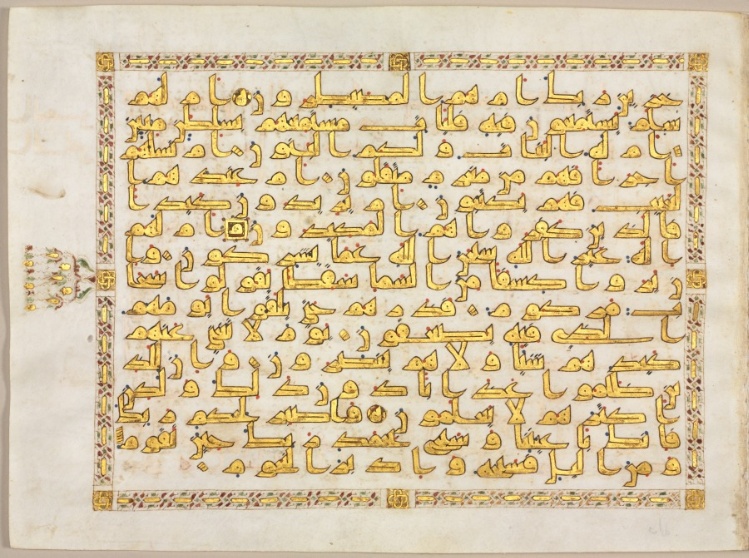
It is through the Arabic language that the Qur’an was revealed to the Prophet Muhammad in the 600s. As a result, calligraphy is celebrated as the highest form in Islamic art. The verses (ayat) written here come from the 53rd chapter (surah) of the Qur’an, also known as the Surah An-Najm, the Chapter of the Star. The significance of the Qur’an provides an explanation for the importance of calligraphy, but its use was not restricted to religious texts. Many objects in the museum's Islamic collection bear calligraphic inscriptions and come from secular contexts, displaying the versatility and creativity of this art form.
A two-page manuscript spread features five lines of bold black Arabic calligraphy on aged tan paper. Small circular gold rosettes with black details punctuate the text as verse markers. The paper displays mottled brown stains and frayed edges, with a central vertical crease dividing the composition. Fine white lines resembling cracks mark the surface, while text from the reverse side shows through faintly in several areas.

Qur'an Manuscript Folio

1300s–1400s

Egypt, Mamluk sultanate (1250–1517)

See Also
Visually Similar by AI

Contact Us

The information about this object, including provenance, may not be currently accurate. If you notice a mistake or have additional information about this object, please fill out the appropriate request form linked below:

Update or Correct Artwork Information

Imagery or Rights for Non-Open-Access Artworks

Report a Website Issue

Further Questions About This Artwork