Artwork Page for Forbidden to the Vulgar

Details / Information for Forbidden to the Vulgar

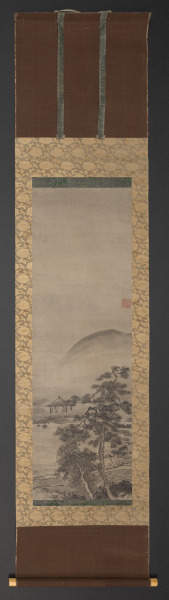
Forbidden to the Vulgar

一俗不到図

late 1800s-early 1900s
(Japanese, 1745–1820)
Measurements
With mount: 67.2 cm (26 7/16 in.); Painting only: 134.6 x 51.1 cm (53 x 20 1/8 in.)
Public Domain
You can copy, modify, and distribute this work, all without asking permission. Learn more about CMA's Open Access Initiative.
Location
Not on view
?

Did You Know?

Gyokudo painted in the Nanga style (literary men's school of painting), originally influenced by 18th-century Chinese painting.

Description

Beneath looming peaks, an assortment of buildings is partially visible through the trees in this work. The artist, Uragami Gyokudō, was an esteemed player of the guqin, a Chinese seven-stringed instrument. At the age of 50, he abandoned his government post in Okayama in western Japan and took up painting in earnest. He traveled the country with his sons and ultimately settled in Kyoto, where he enjoyed a life of music, painting, and the companionship of scholars.
A hanging scroll in black and gray ink depicts a mountainous landscape on tan paper. In the foreground, small houses are nestled within dense trees. A large, rounded mountain peak rises centrally, defined by repetitive horizontal brushstrokes. Fainter, vertical peaks recede into the distance. In the upper left, columns of Chinese calligraphy and a small red seal mark the composition.

Forbidden to the Vulgar

late 1800s-early 1900s

Uragami Gyokudō

(Japanese, 1745–1820)
Japan, Edo period (1615–1868)

See Also
Visually Similar by AI

Contact Us

The information about this object, including provenance, may not be currently accurate. If you notice a mistake or have additional information about this object, please fill out the appropriate request form linked below:

Update or Correct Artwork Information

Imagery or Rights for Non-Open-Access Artworks

Report a Website Issue

Further Questions About This Artwork