Artwork Page for Portrait of Basho

Details / Information for Portrait of Basho

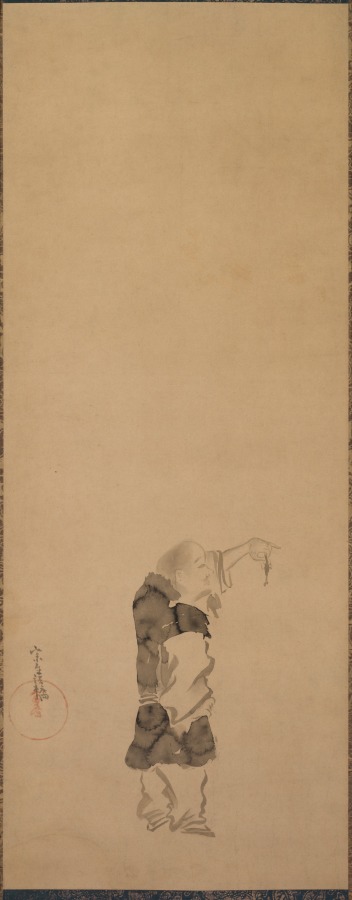
Portrait of Basho

1700s
(Japanese, active 1700s)
Measurements
Painting only: 28.2 x 47 cm (11 1/8 x 18 1/2 in.); Including mounting: 112.5 x 64.2 cm (44 5/16 x 25 1/4 in.)
Credit Line
Public Domain
You can copy, modify, and distribute this work, all without asking permission. Learn more about CMA's Open Access Initiative.
Location
Not on view

Description

The 15th-century poet Matsuo Basho is still considered Japan’s greatest master of the haiku poem, a short, 17-syllable verse form that relates some aspect of nature to the human experience. Although he was one of the most celebrated men of his day, he pursued a simple life of self-imposed poverty and solitude. In this portrait, Ichijun alluded to Matsuo’s haiku about the transient life: warau beshi naku beshi, waga asagao no, shibomu toki (to smile or to cry when my face in the morning [glory] is wilted).
An ink and color painting depicts Basho, an older man with light skin tone. He tilts his head upward to our left with eyes closed and mouth slightly open. He wears a black cap and a dark robe over a light undergarment. A vine with green leaves curves from the upper left around his figure toward the right. Vertical Japanese calligraphy and a red seal appear on our right.

Portrait of Basho

1700s

Ichijun

(Japanese, active 1700s)
Japan, Edo period (1615–1868)

See Also
Visually Similar by AI

Contact Us

The information about this object, including provenance, may not be currently accurate. If you notice a mistake or have additional information about this object, please fill out the appropriate request form linked below:

Update or Correct Artwork Information

Imagery or Rights for Non-Open-Access Artworks

Report a Website Issue

Further Questions About This Artwork