Artwork Page for Seated Amitābha

Details / Information for Seated Amitābha

Seated Amitābha

阿彌陀佛

late 1500s–early 1600s
Measurements
Overall with knobs: 236.9 x 105.7 cm (93 1/4 x 41 5/8 in.); Painting only: 130.8 x 75 cm (51 1/2 x 29 1/2 in.)
Public Domain
You can copy, modify, and distribute this work, all without asking permission. Learn more about CMA's Open Access Initiative.
Location
Not on view
?

Did You Know?

Originally, this scroll was acquired by the museum as a Korean work, but has now been tentatively reattributed as Ming period Chinese.

Description

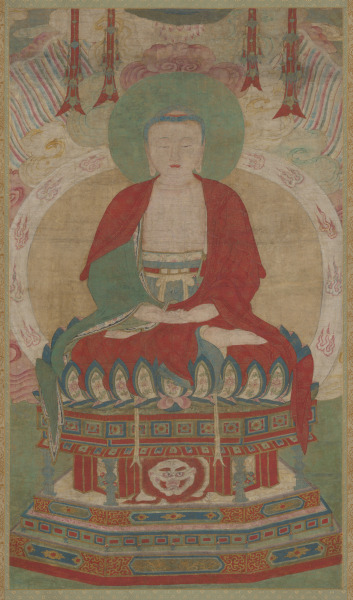
This magnificent Buddha, called Amitābha (literally, “infinite light”) is seated on a lotus pedestal with both palms facing up over crossed legs, suggesting that it is in deep meditation. In contrast to the richly ornamented throne on which the Buddha is seated, the figure itself is devoid of any jewelry or decorative attributes, emphasizing its enlightened status and detachment from worldly affairs. The lion head in the center of the pedestal is a motif from Central Asia, which can also be seen in the halo or nimbus of Chinese Buddhist stone steles.
A vertically oriented hanging scroll depicts Amitābha, a figure with a light skin tone, seated cross-legged on a lotus throne atop a tiered pedestal. He faces forward with downcast eyes, hands resting in his lap. He wears a red robe over a green garment. A light green circular halo frames his head, which features blue knobbed hair, while a larger white halo encircles his body. Pink clouds and red tassels hang above.

Seated Amitābha

late 1500s–early 1600s

Chinese, Ming dynasty (1368-1644)

See Also
Visually Similar by AI

Contact Us

The information about this object, including provenance, may not be currently accurate. If you notice a mistake or have additional information about this object, please fill out the appropriate request form linked below:

Update or Correct Artwork Information

Imagery or Rights for Non-Open-Access Artworks

Report a Website Issue

Further Questions About This Artwork