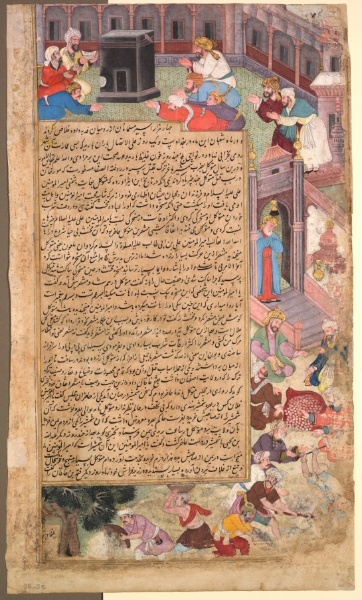
Artwork Page for Hunting with falcons in a landscape; verso: Calligraphy of Chaghatai Turkish poems in praise of wine, Sultan Muhammad Nur (Persian, c. 1472–1536) and Mirza Muhammad (probably Persian, active c. 1520s)

Details / Information for Hunting with falcons in a landscape; verso: Calligraphy of Chaghatai Turkish poems in praise of wine, Sultan Muhammad Nur (Persian, c. 1472–1536) and Mirza Muhammad (probably Persian, active c. 1520s)

Hunting with falcons in a landscape; verso: Calligraphy of Chaghatai Turkish poems in praise of wine, Sultan Muhammad Nur (Persian, c. 1472–1536) and Mirza Muhammad (probably Persian, active c. 1520s)

c. 1558–60; borders added probably 1700s

attributed to Abd al-Samad

(Persian, c. 1510–1600)
Measurements
Page: 35.7 x 24.3 cm (14 1/16 x 9 9/16 in.); Painting: 21.5 x 13 cm (8 7/16 x 5 1/8 in.)
Public Domain
You can copy, modify, and distribute this work, all without asking permission. Learn more about CMA's Open Access Initiative.
Location
Not on view
?

Did You Know?

The hunter’s glove is on the ground, as he pulls his falcon off the duck.

Description

The Mughals hunted on horseback with falcons. The hunting party would ride out into the wild and flush the prey. Then, its hood removed, the falcon would chase the prey and bring it down. From childhood Akbar loved hunting, and this painting may be a rare depiction of Akbar as a youth at the lower left, with the black feather in his white turban. The falcon that has caught a duck has been hooded and is being passed between the young man and his bearded companion. This important work was painted by one of the Persian artists Akbar’s father brought to India from Iran. The inscription at the upper right gives the name of one of the other Persian artists, but it is probably an erroneous later addition.

This page of delicately illuminated calligraphy from the pre-Mughal period was mounted into a Mughal album. The poems are written in the native language of the Mughals, a form of Turkish called Chaghatai, using a flowing form of Arabic script called nasta‘liq. The Mughals self-consciously adopted Persian as their official court language, so few Chaghatai books or works of calligraphy were made for them. The quatrain in the center reads:
The wine has made an attempt on my life, Since it is the wine that can wear down the pain of separation. O Sufi! Let the mosque be for you, and the tavern for me, Since you need to arrive at the Spring of Kowsar, while I am in need of wine! The Spring of Kowsar is where the righteous quench their thirst in the afterlife.
A two-page manuscript spread displays a hunt scene and Persian calligraphy. On the left, men with light skin on horseback and foot hunt with falcons across rocky, tan hills. One hunter on a dappled horse wears a bright red tunic. On the right, diagonal panels of black calligraphy sit within elaborate gold and blue floral borders. Smaller triangular blue sections with gold patterns flank the text. Intricate decorative borders frame both pages.

Hunting with falcons in a landscape; verso: Calligraphy of Chaghatai Turkish poems in praise of wine, Sultan Muhammad Nur (Persian, c. 1472–1536) and Mirza Muhammad (probably Persian, active c. 1520s)

c. 1558–60; borders added probably 1700s

Abd al-Samad

(Persian, c. 1510–1600)
Mughal India, court of Akbar (reigned 1556–1605)

See Also

  • Department
    Indian and Southeast Asian Art
  • Medium
    Tempera
  • Credit line
    Gift In Honor of Madeline Neves Clapp; Gift of Mrs. Henry White Cannon by Exchange; Bequest of Louise T. Cooper; Leonard C. Hanna Jr. Fund; From the Catherine and Ralph Benkaim Collection


Visually Similar by AI

Contact Us

The information about this object, including provenance, may not be currently accurate. If you notice a mistake or have additional information about this object, please fill out the appropriate request form linked below:

Update or Correct Artwork Information

Imagery or Rights for Non-Open-Access Artworks

Report a Website Issue

Further Questions About This Artwork