Artwork Page for Symbols of Longevity: Deer under Peach and Pine

Details / Information for Symbols of Longevity: Deer under Peach and Pine

Symbols of Longevity: Deer under Peach and Pine

1801
(Japanese, 1761–1823)
Measurements
Overall: 197.8 x 68.7 cm (77 7/8 x 27 1/16 in.); Painting only: 135 x 54 cm (53 1/8 x 21 1/4 in.); Scroll: 197.8 x 74.6 cm (77 7/8 x 29 3/8 in.)
Public Domain
You can copy, modify, and distribute this work, all without asking permission. Learn more about CMA's Open Access Initiative.
Location
Not on view

Description

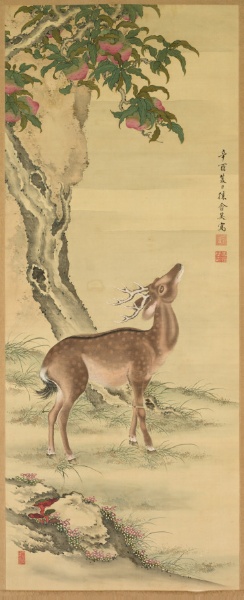
This pair of hanging scrolls is replete with images symbolizing longevity. Peaches, associated with immortality, hang in abundance from a tree in the left scroll, while pines, known for being eternally green, twist together in the right scroll. Beneath the trees stand two bucks, one of whom gazes at a doe seated on the ground as he licks his coat. Medicine made from deer antlers is said to promote health. Mushrooms, in bright red and green, seen in the left scroll, are said to confer immortality upon those who eat them, and the small waterfall in the right scroll speaks to the infinite flexibility and abundance flowing through life. Toda Tadanaka, the son of the ruler of Noto province and a military leader himself, trained with trained with Mori Ransai (1740-1801), a painter known for colorful bird-and-flower compositions in the style of Shen Nanping. The style is more generally referred to as the Nagasaki style, indicating the port city in which a number of Chinese painters were active in the Edo period (1615-1868).
Two hanging scrolls depict spotted deer in pale yellow landscapes. In the left scroll, a buck gazes up at pink peaches on a gnarled tree, beside vertical calligraphy and red seals. In the right scroll, one buck licks its back while another rests on rocky ground beneath a pine tree. Both foregrounds are sprinkled with small pink flowers among gnarled, textured bark and craggy rocks.

Symbols of Longevity: Deer under Peach and Pine

1801

Toda Tadanaka

(Japanese, 1761–1823)
Japan, Edo period (1615–1868)

See Also

Visually Similar by AI

Contact Us

The information about this object, including provenance, may not be currently accurate. If you notice a mistake or have additional information about this object, please fill out the appropriate request form linked below:

Update or Correct Artwork Information

Imagery or Rights for Non-Open-Access Artworks

Report a Website Issue

Further Questions About This Artwork