Artwork Page for Egret and Reeds

Details / Information for Egret and Reeds

Egret and Reeds

백로도 [白鷺圖]

late 1800s
(Korean, 1843–1919?)
Measurements
Overall: 196 x 61 cm (77 3/16 x 24 in.)
Public Domain
You can copy, modify, and distribute this work, all without asking permission. Learn more about CMA's Open Access Initiative.
Location
Not on view
?

Did You Know?

Yang Ki-hun was one of the most commercially successful painters known for decorative bird-and-flower subjects.

Description

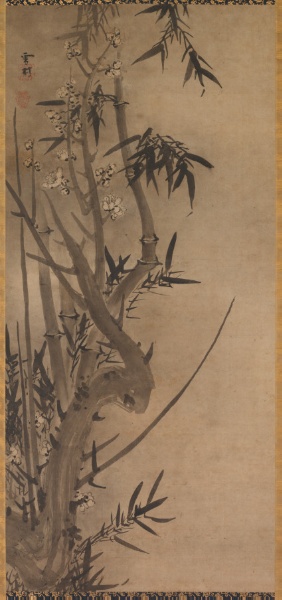
In this hanging scroll, an egret walks along the shores of a salt marsh where reeds abundantly grow. Native to Pyongyang, the artist Yang Ki-hun had no rival in bird-and-flower themes. The Taedong River estuary, one of Pyongyang’s beloved natural sites, may have been Yang’s favorite spot to observe and sketch various water birds.

Yang treated his subjects of flora and fauna with an observant naturalist’s view, yet his choice of subjects—an egret and reeds—is deeply rooted in traditional symbolic language: the egret stands for the scholarly reclusive life, while reeds indicate humility and modesty.
A vertically oriented hanging scroll in black ink depicts a long-legged bird among reeds. Gestural washes of gray and black ink define the bird, which faces our left with its head tucked. Above, a slender reed stalk with a seed cluster arcs from our right. Dark, frenzied strokes create marsh plants against the pale paper ground. Columns of black calligraphy and red seals accent the left and top right edges.

Egret and Reeds

late 1800s

Yang Ki-hun (Seuk-Eun)

(Korean, 1843–1919?)
Korea, Joseon dynasty (1392–1910)

See Also

Visually Similar by AI

Contact Us

The information about this object, including provenance, may not be currently accurate. If you notice a mistake or have additional information about this object, please fill out the appropriate request form linked below:

Update or Correct Artwork Information

Imagery or Rights for Non-Open-Access Artworks

Report a Website Issue

Further Questions About This Artwork