Image

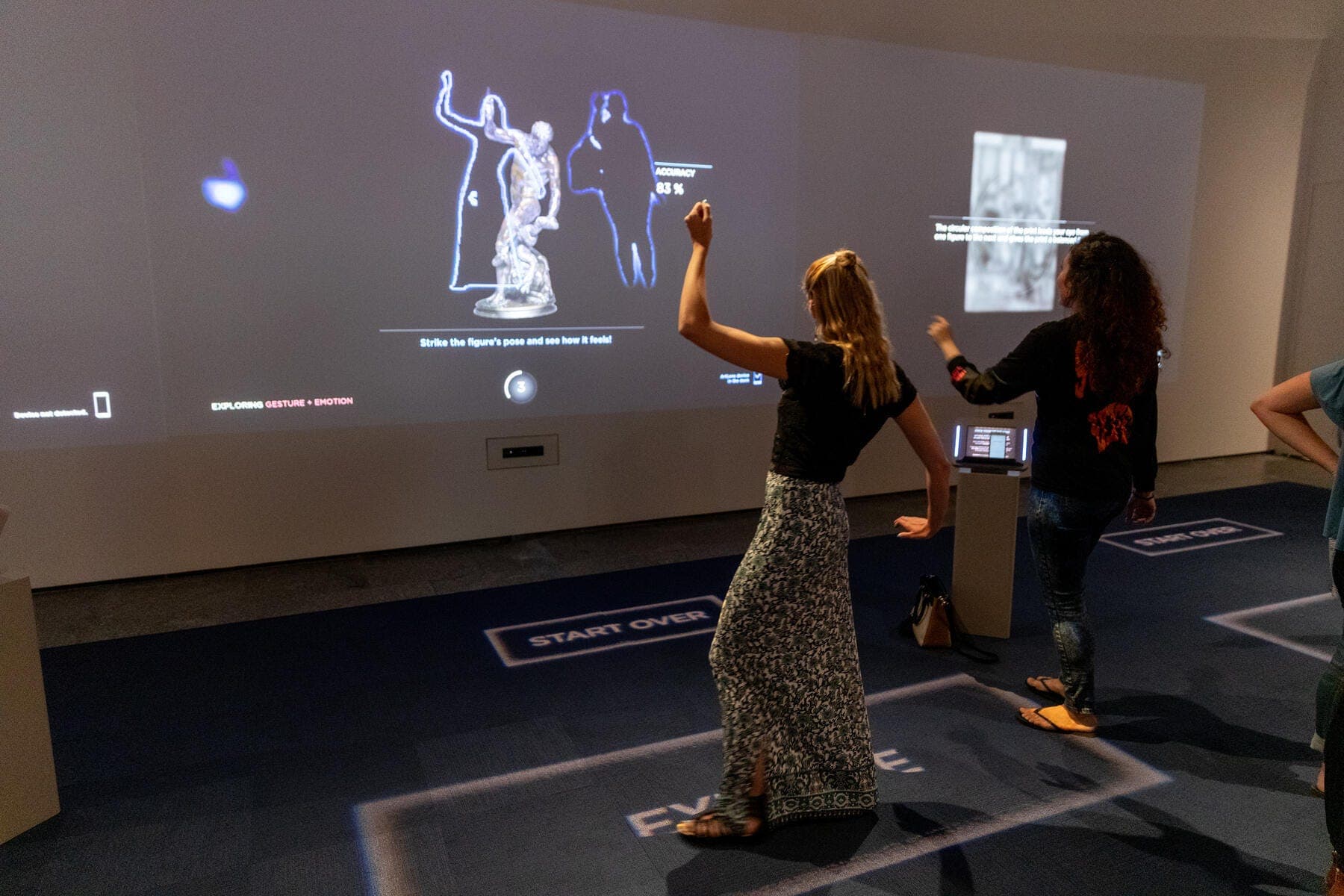
ArtLens Exhibition is an experiential gallery that puts you—the viewer—into conversation with masterpieces of art, encouraging engagement on a personal, emotional level. ArtLens Exhibition features a collection of 20 masterworks of art that will rotate every 18 months to provide new, fresh experiences for repeat visitors. The art selection and barrier-free digital interactives inspire you to approach the museum’s collection with greater curiosity, confidence, and understanding. Transitioning away from touchscreen technology, ArtLens Exhibition interactives use gesture-sensing projections that respond seamlessly to body movement and facial recognition as you approach, immersing you in the experience. There are 16 innovative games, centered on the following themes: Composition, Symbols, Gesture and Emotion, and Purpose. Each artwork in ArtLens Exhibition has two corresponding games in different themes, allowing you to dive deeper into understanding the object. ArtLens Exhibition opened to the public at the Solstice Party in June 2017. In June 2019, ArtLens Exhibition reopened with a new display of 21 artworks from across the collection—from medieval to decorative arts to contemporary.
New features include the following:
Articulating a theme, or a framework, that would shape the way we interpreted and presented the objects was important for this installation. The broad question “What can art be?” provided us with multiple entry points into thinking about and engaging with such a diverse group of objects. In the exhibition, we provide one answer, but because we believe there is more than one way to understand a work of art, we encourage visitors to consider their own reactions and ideas. One unique aspect about ArtLens Exhibition is that it provides an opportunity to look at and consider connections across time and place. Each installation can create a dialogue among the artworks and the digital interactives.
The ArtLens Exhibition welcomes nontraditional museum visitors by reducing the intimidation of the art museum and providing visitors the tool sets to look closer, dive deeper, and begin a relationship with the collection. Frequent museum visitors return again and again to ArtLens Exhibition to see and explore the CMA's collection in a new way.
Gaze Tracker encourages visitors to explore the elements and artistic choices that impact the composition of an artwork. At Gaze Tracker, visitors sit in front of an ADA-compliant monitor, wait for the interactive to calibrate with their eyes, and look at an artwork from the CMA’s collection for 15 seconds. Innovative eye-tracking technology reveals accurately where a visitor focuses when looking at the work of art, increasing the visitor’s understanding of how an artist’s compositional choices influence how they look at art. On a large video projection viewable by other visitors and on the individual monitor, the interactive shows visitors the path their eyes took while observing the work of art, including what grabbed their attention first, what detail they viewed the longest, and what elements they ignored. At the end of the interactive, visitors can see an interpretation of the artist’s compositional intent as well as the artwork’s identification, gallery location, and aggregate results from other visitors.

Express Yourself is a machine-learning interactive that uses facial-recognition software to identify visitors’ emotional responses to artwork from across the CMA’s collection. To begin the interactive, visitors position themselves three feet from one of two touchscreens—one of which is ADA compliant. Next, visitors react to a large sculpture by Frank Stella featured in ArtLens Exhibition, an object that evokes strong, diverse emotional reactions. The visitor’s preliminary reactions enable the facial-recognition software to calibrate and statistics show how their initial results compare with others stored by the interactive. Visitors are then asked to react to a variety of artworks from across the CMA’s collection for 30 seconds. As visitors view each individual artwork, their facial expressions are registered as happy, surprised, confused, distasteful, fearful, or sad. When the 30 seconds are up, visitors see all their emotional reactions associated with the artworks they viewed. They can then select any artwork to begin an engaging mission that encourages deeper looking while launching them into the museum galleries to locate the artwork. Visitors can dock their iOS or Android device at Express Yourself and missions will save directly to the “You” section of ArtLens App via Bluetooth technology. Additionally, the interactive captures a video that features the visitor’s emotional reactions and images of the artworks that saves directly to the device’s camera roll.
Gestures and emotions may be the most identifiable elements in a work of art, but they can also be the most complex to decipher. The Gesture and Emotion experiences mirror your expressions, and empower you to alter works of art to understand how expression can change meaning.
The exploration of symbols necessitates an understanding of an artist’s secular, religious, and personal beliefs. These interactives provide satisfying and simple entry points into the complex world of encoded artworks.
Explore and learn about an object’s original purpose.
The composition experience reveals the underlying structure that holds an artwork together. Fun, intuitive, full-body gestures and gaze-tracking games explore the concepts of geometry, all-over, and multiple focus compositions, and provide an entry point into the more nuanced pedagogy of image organization.