The Cleveland Museum of Art

Collection Online as of July 13, 2026

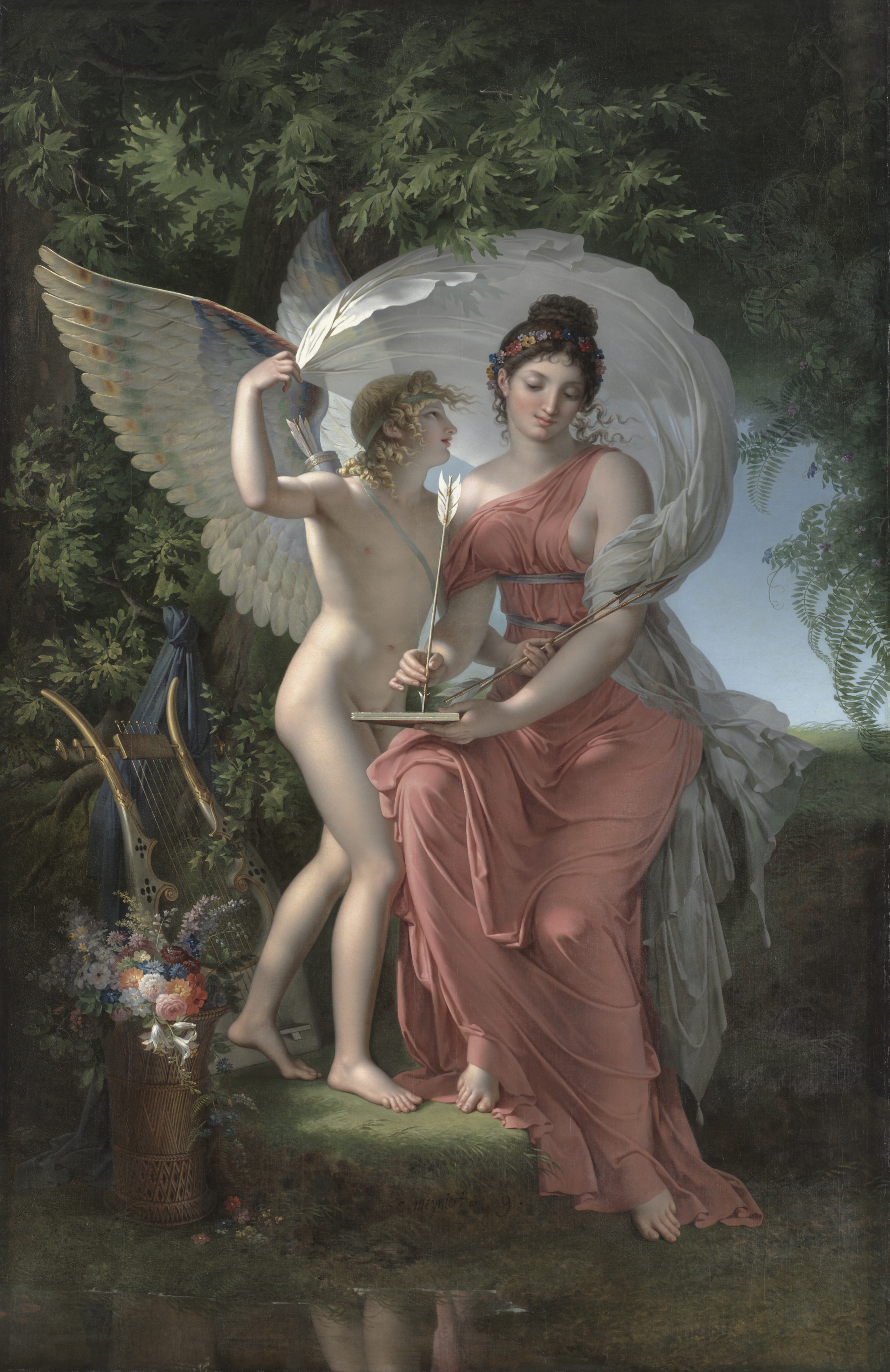
A vertically oriented oil painting depicts Erato, a muse with light skin tone in a pink gown and floral wreath, seated beside a nude Cupid with colorful wings. Erato holds several arrows, pressing one white-fletched tip against a tablet they share. Cupid looks up at her while holding a stylus and grasping a billowing white cloth behind them. A gold lyre and flower basket rest to our left within a lush, green forest.

Erato, Muse of Lyrical Poetry

1800
(French, 1768–1832)
Overall: 273 x 176 cm (107 1/2 x 69 5/16 in.)

Description

Erato, the muse of lyric and erotic poetry, is often depicted with a golden arrow received from Eros or Cupid, a sign of the emotion that inspires her.
  • Before entering the collection, this entire suite of five monumental paintings by Charles Meynier had numerous conservation issues, including pronounced discolored varnish, years of accumulated grime, and canvases that were detaching from their stretchers, creating large buckles along the edges. The CMA designed a four-year-long comprehensive conservation campaign to address these concerns, which involved removing the grime, reducing the discolored varnish, flattening buckles and undulations in the canvas, followed by inpainting mainly to compensate for pronounced traction cracking in the original paint layers. Traction cracking occurs when the top layers of paint dry faster than the underlayers, creating breaks in the top layers, revealing the underlying preparatory layers that were not intended to be seen. Horizontal cracking at regular intervals is present in each painting and is likely caused by rolling the canvases to transport them to the Castella chateau in Wallenreid, Switzerland, where the paintings remained until the CMA purchased them in 2003. At some point, while in the Wallenreid chateau, likely for prudish reasons, the Castella family had an artist paint a drapery over Cupid. Fortunately, the lead white–containing paint of the overpainted drapery was applied over top of an old varnish layer. This barrier of thick, brittle natural resin varnish allowed for the careful and painstaking mechanical removal of the overpainted drapery, revealing the artist’s intended composition. The exquisitely carved gold leaf frames are original to the paintings.
  • In 1819, Nicolas-Antoine de Castella, general of the Swiss regiments in France, purchased the paintings and placed them in his Castle of Wallenreid, Switzerland; direct descendants; Pierre de Castella, Mannaz, Switzerland.
  • Bellenger, Sylvain, Paul J. and Edith Ingalls Vignos Jr. "Magnificent Muses", Cleveland Museum of Art. Cleveland Art: The Cleveland Museum of Art Members Magazine. Vol. 44 no. 01, January 2004 Mentioned & reproduced: 6-7 archive.org
    Bracken Sparks, Amy, "Disappearing Act", Cleveland Museum of Art. Cleveland Art: The Cleveland Museum of Art Members Magazine. Vol. 48 no. 5, May/June 2008 Mentioned & reproduced: p. 10 archive.org
    Meynier, Charles, and Isabelle Mayer-Michalon. Meynier's Masterpiece: The Farewell of Telemachus and Eucharis : an Important Rediscovery from the Salon of 1800, London : Daniel Katz Gallery, 2019. 26. Mentioned and reproduced: p. 26-27, fig. 13.
  • {{cite web|title=Erato, Muse of Lyrical Poetry|url=false|author=Charles Meynier|year=1800|access-date=13 July 2026|publisher=Cleveland Museum of Art}}

Source URL:

https://www.clevelandart.org/art/2003.6.2