Enjoy Free Daily Admission and Holiday Events at the Cleveland Museum of Art
- Press Release
Contact the Museum's Media Relations Team:
(216) 707-2261
marketingandcommunications@clevelandart.org
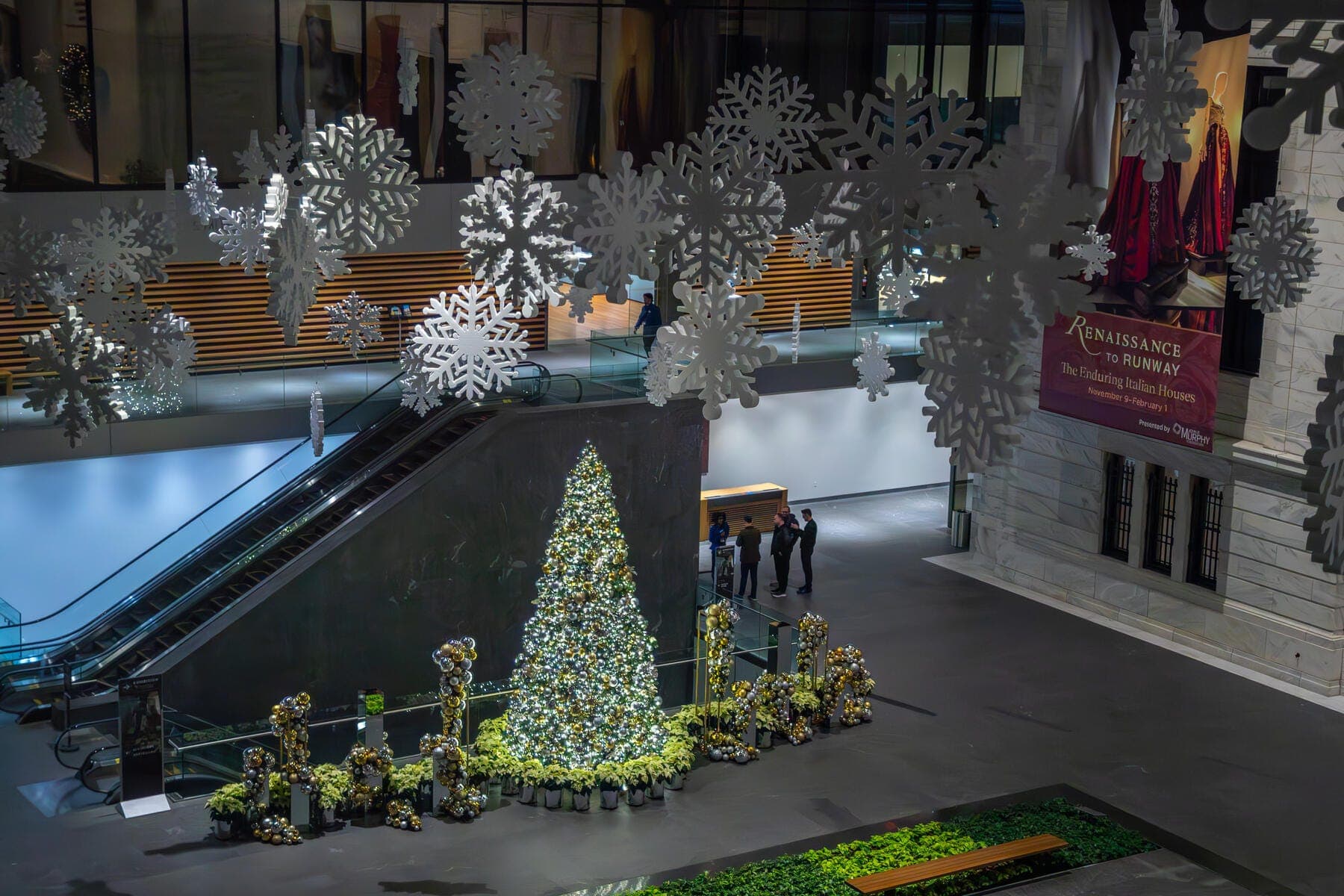
Seasonal Snowflakes, Wreathes, and Tree Spread Festive Holiday Spirit
CLEVELAND (November 21, 2025)—Make your season bright this year with a trip to the Cleveland Museum of Art (CMA). From the CMA’s largest-ever fashion exhibition and world-class art to holiday music, family activities, holiday-themed nightlife and traditions tours, there’s something for everyone. With free daily admission, it’s the ideal place for people of all ages and groups of all sizes.
While you’re here, be sure to check out our newest exhibition, Renaissance to Runway: The Enduring Italian Houses. Tickets for this highly anticipated exhibition are now on sale. Reserve yours today.
Holiday Musical Performances
- Cleveland Chamber Choir (Wednesday, December 3, 2025, 6:00–7:00 p.m.)
- The Music Settlement (Wednesday, December 10, 2025, 6:00–7:00 p.m.)
- A Musical Prelude for the Holidays (Friday, December 12, 2025, 6:00–7:00 p.m.)
- Linking Legacies (Friday, December 19, 2025, 6:00–7:00 p.m.)

Events
MIX: Snow Globe
Friday, December 5, 2025
6:00–10:00 p.m.
Ticket Required
Join us for MIX: Snow Globe, a winter holiday–themed party that features music from across the world. Hailing from Lagos, Nigeria, and nominated for Cleveland Magazine’s “Best DJ of 2024,” DJ Ik Dubaku spins Afrobeat, Afro house, and dance music from Asia and beyond. He is joined by DJ Flaco Flash, who spins Latin music from South America, Central America, and the Caribbean. Head to the Donna and James Reid Gallery (gallery 217) to hear Gabrieli’s Horns perform classic holiday tunes arranged for brass quintet from 6:30 to 7:30 p.m. Be sure to take photos amid the museum’s holiday decor in the atrium. Themed food and drink items, including cocktails, beer, and wine, are available to purchase from Bon Appétit.
With admission to MIX, guests can view the CMA’s newest fashion exhibition, Renaissance to Runway: The Enduring Italian Houses, which examines the art historical inspirations that fuel the recent creative Italian lexicon.
Disclaimer: No full-face masks, heavy face paint, glitter, weaponlike props, or excessively oversized costumes are permitted. All outfits are subject to security screening. The Cleveland Museum of Art may refuse entry to any visitor whose attire does not comply with these requirements.
MIX is a 21+ event.
Youth and Family Programming
- Open Studio (Sundays, December 7 and 21, 2025, 10:00 a.m.–2:00 p.m.)
- Play Day: Illuminate (Sunday, December 14, 2025, 10:00 a.m.–2:00 p.m.)
- Holiday Pop Up! Open Studio (Saturday and Sunday, December 27 and 28, 2025, 10:00 a.m.–2:00 p.m.)

Holiday Traditions Tours
Weekly on Wednesdays, 5:45–6:45 p.m., November 26 to December 17, 2025
Weekly on Saturdays, 3:00–4:00 p.m., November 29 to December 27, 2025
Weekly on Sundays, 3:00–4:00 p.m., November 30–December 28, 2025
Ames Family Atrium
Step into the spirit of the season with our Holiday Traditions Tour! Celebrate light, gifts, parties, and family gatherings while discovering how winter holidays have been marked across time and cultures. From ancient festivals of the solstice to modern celebrations, this tour highlights art and objects that tell stories of warmth, generosity, and togetherness during the darkest months of the year.
No tours on Wednesday, December 24—the museum closes at 4:00 p.m. on Christmas Eve.
To schedule private tours for adult groups of 10 or more, please contact grouptours@clevelandart.org or call 216-707-2752.
And for anyone looking to spread joy, the CMA offers gift memberships. You can also visit our beloved museum store for a variety of gifts by local artists and global fair-trade companies, books, and exhibition catalogues, and Renaissance to Runway–inspired merchandise—something for everyone on your list.
The CMA’s current hours of operation are Tuesday, Thursday, Saturday, and Sunday, 10:00 a.m. to 5:00 p.m., and Wednesday and Friday, 10:00 a.m. to 9:00 p.m. The museum is closed on Mondays.
Holiday Gifts
CMA Membership
Share your love of art by purchasing a CMA membership. Recipients can take advantage of exclusive discounts and free exhibition tickets. Shop online at cma.org/giftmemberships to choose the perfect level for your loved one.
Museum Store
Find a special holiday gift at the museum store. Choose from a variety of cards, posters, and gifts based on exhibitions and works from the museum’s collection as well as unique jewelry, clothing, accessories, and other items from local artists and global fair-trade companies. Members receive a 15 percent discount in the museum store.
The CMA is closed on December 25 and January 1. On December 24 and December 31 the CMA closes at 4:00 p.m.
Enjoy All That CMA Has to Offer
Visitors can also explore free exhibitions and favorite galleries, enjoy lunch in the museum’s Provenance café or restaurant, relax in the Ames Family Atrium—Cleveland’s largest free interior public space—and snap a photo with family and friends in front of the holiday wreath, tree, menorah, and kinara.
Renaissance to Runway: The Enduring Italian Houses
Sunday, November 9, 2025–Sunday, February 1, 2026
The Kelvin and Eleanor Smith Foundation Exhibition Hall
Fashion as a medium undeniably addresses ideas that transcend time from the past into the present. Through the majestic creations of more than 100 modern and contemporary Italian fashions and accessories in dialogue with Italian fine, decorative, and textile arts from the 1400s to the early 1600s, Renaissance to Runway: The Enduring Italian Houses examines the art historical inspirations that fuel recent creative Italian lexicon, expanding fantasies of the Renaissance, Mannerist, and early Baroque periods.
More than 500 years ago, families, or “houses,” who ruled the states across the Italian peninsula, such as the Medici of Florence and the Sforza of Milan, used fashion as a form of power and influence, from dictating fashionable styles that were immortalized through painted portraits to controlling textile production as a form of currency. Conversely, since the turn of the 1900s, rising Italian fashion companies, also called “houses,” have been founded by prolific individuals and families who dominate global style with unmatched design craftsmanship, quality fabrics, and enthralling aesthetics. From Versace and Valentino to Ferragamo and Capucci, these houses have interpreted Italian early modern–period aesthetics to develop fresh perspectives throughout the fashion landscape.
This exhibition illustrates how fashion, in all of its change, is a continuous thread that uncovers history’s complexities as it materializes contemporary beauty.
Presented by the John P. Murphy Foundation.
Major support is provided by Courtney and Michael Novak. Generous support is provided by Sandra and the late Richey Smith and the Carol Yellig Family Fund. Additional support is provided by Dr. Russell A. Trusso.
Programming
Coloring Renaissance to Runway: Fashioning Red in Italian Fashion
Tuesday, December 2, 2025, 12:00–1:00 p.m.
Gartner Auditorium, Suzanne and Paul Westlake Performing Arts Center
Speaker: Darnell-Jamal Lisby, Associate Curator of Fashion
During the Italian early modern period, the color red was prominently adopted into style, becoming a symbol of luxury. Created using various dyestuffs, including those derived from insects such as the kermes and the cochineal, red was a symbol of power. Its essence has transcended time, conveying similar connotations in contemporary Italian fashion, which highlights the color’s connections to exuberant elegance and sensuality. Presented by the Associate Curator of Fashion Darnell-Jamal Lisby, this lunchtime lecture explores how the color red helped define various narratives elicited by the Renaissance to Runway: The Enduring Italian Houses project. From Giorgio Armani to Gianfranco Ferré, from Versace to Alberta Ferretti, red represents a line from the past into the present and future modes of creativity.
Renaissance to Runway Make and Sip: Fashion Sketchbooks
Wednesdays, December 10 and December 17, 2025, 6:00–8:00 p.m.
Ames Family Atrium
Ticket Required
Instructor: Joanne Arnett
Join us for a creative evening of art making, drinks, and ambience. With fashion illustrator and instructor Joanne Arnett, learn to sketch your own look inspired by the fashion on view in the new exhibition Renaissance to Runway: The Enduring Italian Houses . Enjoy wine, beer, and light snacks as you sketch, sip, and get inspired by the centuries of Italian haute couture.
Each ticket includes a voucher for one beer, cocktail, or glass of wine. Any additional beverages or snacks are available for purchase.
Artist in the Atrium: Renaissance Arts
Saturday, December 13, 2025, 11:00 a.m. –3:00 p.m.
Free; No Ticket Required
Stop by the Ames Family Atrium between 11:00 a.m. and 3:00 p.m. to get a firsthand look at the art-making process. Each session provides the opportunity to engage and interact with a different Northeast Ohio maker during pop-up demonstrations and activities. See their work unfold and learn how artists create. Explore a related selection of authentic objects from the CMA’s Education Art Collection in a pop-up Art Up Close session. See, think, and wonder.
Join the Society for Creative Anachronism in the Ames Family Atrium to celebrate Renaissance-era art-making processes. Learn about calligraphy, illumination, Renaissance-era clothing and music, and more in this fun themed event. Explore Renaissance artwork on view in multiple museum exhibitions: Renaissance to Runway: The Enduring Italian Houses; Filippino Lippi in Rome; In Vino Veritas (In Wine, Truth); and Pintoricchio Magnified: An Immersive Digital Experience. Wear your best Renaissance-era costume and try your hand at historical art-making processes.
Free Exhibitions
Practice and Play in Japanese Art
Through Sunday, November 30, 2025
Kelvin and Eleanor Smith Foundation Japanese Art Gallery | Gallery 235A
Free; No Ticket Required
From the 1200s to the 1800s, developing a balanced set of military (bu, 武) and cultural (bun, 文) skills was considered important for the elites of Japan’s warrior class. The artworks in this gallery relate to these divergent yet complementary pursuits. Horse riding and falconry were among the martial arts, along with archery. Poetry competitions tested people’s ability to compose verse on the spot, and incense games challenged them to identify particular scents. The practices of calligraphy, music, painting, and games of strategy, often informed by Chinese precedents, provided multiple paths to personal cultivation and community.
Native North American Textiles and Works on Paper
Through Sunday, December 14, 2025
Sarah P. and William R. Robertson Gallery | Gallery 231
Free; No Ticket Required
On display from the permanent collection are two Diné (Navajo) textiles from the late 1800s, as well as a watercolor from the 1930s made by Oqwa Pi, a member of the San Ildefonso Pueblo.
Ancient Andean Textiles
Through Sunday, December 14, 2025
Jon A. Lindseth and Virginia M. Lindseth, PhD, Galleries of the Ancient Americas | Gallery 232
Ancient Andean weavers created one of the world’s most distinguished textile traditions. This installation features examples utilizing the tapestry technique, particularly esteemed in antiquity.
Indian Painting of the 1500s: Continuities and Transformations
Through January 11, 2026
Gallery 242B
Free; No Ticket Required
When the 1500s began, the dominant style of Indian painting was flat and abstract with a limited, mainly primary color palette. By the 1520s, a new style emerged with greater narrative complexities and dramatic energy that was to be foundational for later developments. Concurrently, some artists began working in the pastel palette and with delicate motifs reinterpreted from Persian art.
Then, around 1560, with the exuberant patronage of the third Mughal emperor Akbar (born 1542, reigned 1556–1605), artists from different parts of the empire and trained in a variety of Indian styles came together in a new imperial painting workshop. The workshop was led by Persian masters brought from the imperial court in Iran. The formation of Mughal painting shaped by Akbar’s taste for drama and realism had a lasting impact on the cultural life of India. With its naturalism and vibrant compositions, the revolutionary new style was distinct from its predecessors, both Indian and Persian. The paintings in this gallery trace the dramatic changes that occurred during the 1500s alongside compositions that artists chose to retain and reinvent. Central to this story is a manuscript of the Tuti-nama (Tales of a Parrot), an illustrated collection of fables made for Akbar around 1560–65 now in the Cleveland Museum of Art.
In Vino Veritas (In Wine, Truth)
Through Sunday, January 11, 2026
James and Hanna Bartlett Prints and Drawings | Galleries 101A–B
Free; No Ticket Required
For millennia, wine has played a significant role not only in the human diet but also in cultural myths, rituals, and festivities. As a result, wine—its ingredients, making, drinking, and effects on the human body and mind—has been a constant muse for artistic creation. The exhibition In Vino Veritas (In Wine, Truth), a phrase coined by the Roman polymath Pliny the Elder, celebrates the presence and meaning of wine in prints, drawings, textiles, and objects made in Europe between 1450 and 1800. Drawn from the museum’s collection, more than 70 works by artists from throughout Europe explore wine’s myths, symbols, and stories. These images reveal how diverse cultures and religions ascribed meaning and transformational properties to the so-called nectar of the gods.
The ancient Greeks believed that the god Dionysus (in Rome, Bacchus) lived within wine: to drink wine was to partake of the god’s power. Fascinated by ancient culture, Italian Renaissance artists, such as Andrea Mantegna and Raphael, imagined scenes of boisterous festivals, or bacchanalia, along with the exploits of Bacchus and his coterie of satyrs, nymphs, and fauns. In Northern Europe, Pieter Bruegel the Elder, and later Jean-Honoré Fragonard, transformed bacchanalia into raucous peasant festivals and sensuous garden parties fueled by wine, at times tinged with moral judgment. Simultaneously, wine played a critical allegorical role in images made within the Judeo-Christian tradition. The Old Testament and Hebrew Bible traced wine’s invention to Noah. Numerous stories from these texts, portrayed by Lucas van Leyden and others, leveraged wine as an important plot element, with the ability to unify and enlighten, or to incapacitate and deceive. Many artists, such as Albrecht Dürer, used wine, grapes, and the vine to symbolize the Catholic rite of the Eucharist and its origin in Christ’s Last Supper. Throughout the exhibition, wine appears in scenes of devotion, harvest, celebration, music making, and transgression, signaling community cohesion as well as the pleasures—and hazards—of surrendering to one’s senses
Generous support is provided by the Malcolm E. Kenney Curatorial Research Fund.
Eleanor Antin’s Nurse and Hijackers
Through Sunday, January 11, 2026
224B Video
Free; No Ticket Required
In this video, Eleanor Antin draws on the form of popular disaster movies to explore history, contemporary culture, and identity from a feminist perspective. The narrative—a hijacking of a nurse’s plane on its way to Saint-Tropez, France—is enacted by paper dolls, whose voices and gestures are performed by the artist. This unfolds aboard a handcrafted set also made by the artist. Using recognizable styles from film and television of the time, Antin’s feature-length narrative invites viewers to consider the ways that contemporary international politics are represented in the media.
British Portrait Miniatures: Tokens of Love and Loss
Through Sunday, February 15, 2026
Ellen and Bruce Mavec Gallery | Gallery 203B
Free; No Ticket Required
Exchanged as personal mementos or as signs of political allegiance, portrait miniatures first appeared in the French and English courts of the 1520s. Evolved from the art of medieval illuminated manuscripts, miniatures provided a less expensive and more personal alternative to traditional full-scale portraiture. Portrait miniatures were portable luxury objects treasured by their owners both for the cherished portrait and the precious materials from which they were crafted. These might include gold, enamel, diamonds, and locks of human hair.
Their small scale and the fact that people often wore them as jewelry and carried them on their person conveys a different type of intimacy than larger scale portraits. Sitters are often depicted more informally and with the gaze of a particular loved one in mind. Miniatures remained popular for nearly three centuries. The advent of photography in 1839 offered a more cost-effective method of capturing a keepsake likeness, and the portrait miniature faded from fashion.
Juxtaposition and Juncture in Korean Modern and Contemporary Art
Through April 1, 2026
Korea Foundation Gallery | Gallery 236
Free; No Ticket Required
The term juxtaposition here refers to the side-by-side placement of two or more artworks that are significantly different from one another. Featuring Korean modern and contemporary objects that the CMA has collected over the past 15 years, this thematic exhibition juxtaposes them to create an exciting juncture of connections through their visual and material contrasts.
While the selected works were created by Korean artists from diverse backgrounds and different generations, they make a poignant meeting place illustrating how objects from the past inspired contemporary artists to create new experiences and artistic expressions.
Adorning Ritual: Jewish Ceremonial Art from the Jewish Museum, New York
Through Sunday, May 10, 2026
Various Galleries
Free; No Ticket Required
The Cleveland Museum of Art houses an encyclopedic collection, giving visitors valuable insights and perspectives into the lives and cultures of people around the world and throughout time. To enhance its permanent collection and to more fully represent the stories and objects important to our communities, the museum is displaying art on loan from the Jewish Museum, New York, in six galleries.
Most of the works are ritual objects relating to Judaism or the lives of Jewish people, from silver Torah finials to an inlaid marble panel commemorating a marriage. The objects have been placed in context with other works of the same time or region, allowing a fuller narrative to unfold. As you encounter these objects in the galleries, we invite you to consider their relationships to the other works in these spaces.
In addition to the loans from the Jewish Museum, two examples of Jewish ceremonial art from local collections are on display in two additional galleries: an etrog box recently acquired by the Cleveland Museum of Art and a miniature Torah ark on loan from the Mishkan Or Museum of Jewish Cultures in Beachwood, Ohio.
Principal support is provided by Rebecca and David Heller and Gail and Elliott Schlang. Additional support is provided by Michael Frank and the late Pat Snyder, Richard A. Horvitz and Erica Hartman-Horvitz, Mr. and Mrs. David D. Kahan, Marjorie Moskovitz Kanfer and Joseph Kanfer, Dr. Linda M. Sandhaus and Dr. Roland S. Philip, and the Simon Family Foundation, a supporting foundation of the Jewish Federation of Cleveland.
Pintoricchio Magnified: An Immersive Conservation Experience
Through Sunday, August 23, 2026
Gallery 115
Free; No Ticket Required
Through a digital immersive experience, step into the conservation studio and get a behind-the-scenes look at the materials and techniques conservators use to preserve paintings in the CMA collection.
For almost 50 years, Pintoricchio’s Virgin and Child (c. 1490–1500) was in storage at the CMA, its last original layers of blue paint hidden beneath a mask of restoration treatments undertaken in the 1900s. Although considered one of the most significant paintings within the early Italian collection, its complicated restoration history and physical state rendered it largely unexhibitable.
In the most recent conservation treatment, original paint layers were revealed, allowing unparalleled access to Pintoricchio’s original composition, freed from past interventions. This allowed conservators to embark on the rediscovery and reexamination of one of the more damaged paintings within the CMA collection and use cutting-edge technologies to better understand the materials and techniques used by the artist. Through a large digital display, visitors can traverse the layers of the painting and its conservation treatment, examining changing details as if magnified under a microscope.
This exhibition is made possible with support from Jared and Linda Buono Chaney and Carl M. Jenks.
All activities of the Eric T. and Jane Baker Nord Family Conservation Suite are underwritten by the CMA Fund for Conservation.
All digital innovation and technology initiatives at the Cleveland Museum of Art are underwritten by the CMA Digital Innovation Fund.
New Acquisition: Giambologna’s Fata Morgana
Through Tuesday, September 1, 2026
Gallery 117B
Free; No Ticket Required
The Cleveland Museum of Art has acquired Fata Morgana, one of the greatest works by Giambologna (1529–1608), the preeminent sculptor of his generation, and the last known marble sculpture by his hand in a private collection. This rare and internationally renowned figure is being shown in a gallery evoking the Tuscan grotto in which it was originally placed.
Children’s Armor from the Imperial Habsburg Armory in Vienna
Through Sunday, June 4, 2028
Jack, Joseph, and Morton Mandel Armor Court | Gallery 210A
Free; No Ticket Required
Four historically significant suits of armor from the Imperial Habsburg Armory in Vienna, Austria, are being displayed in the armor court for the next three years. The selection focuses on children’s armor and weapons to illustrate how a military education played an important role in training boys to become knights. A few objects from the CMA’s own collection of children’s armor are shown alongside these magnificent loans.
Principal support is provided by the Jack, Joseph, and Morton Mandel Foundation.
American Printed Silks, 1927–1947
Through Sunday, November 8, 2026
Arlene M. and Arthur S. Holden Gallery
Free; No Ticket Required
Between the late 1920s and late 1940s, the US was a leader in printed silks used in fashionable attire and interiors. This exhibition showcases printed silks in the CMA’s collection from four American companies—Stehli Silks Corporation, H. R. Mallinson and Company, Silks Beau Monde, and Onondaga Silk Company.
###
About the Cleveland Museum of Art
The Cleveland Museum of Art (CMA) is renowned for the quality and breadth of its collection, which includes more than 66,500 artworks and spans 6,000 years of achievement in the arts. The museum is a significant international forum for exhibitions, scholarship, and performing arts and is a leader in digital innovation. One of the leading encyclopedic art museums in the United States, the CMA is recognized for its award-winning open access program—which provides free digital access to images and information about works in the museum’s collection—and free of charge to all. The museum is located in the University Circle neighborhood with two satellite locations on Cleveland’s west side: the Community Arts Center and Transformer Station.
The museum is supported in part by residents of Cuyahoga County through a public grant from Cuyahoga Arts & Culture and made possible in part by the Ohio Arts Council (OAC), which receives support from the State of Ohio and the National Endowment for the Arts. The OAC is a state agency that funds and supports quality arts experiences to strengthen Ohio communities culturally, educationally, and economically. For more information about the museum and its holdings, programs, and events, call 888-CMA-0033 or visit cma.org.