ArtLens Reimagined
- Special Exhibition
- Featured
The Intersection of Art, Technology, and Innovation
ArtLens is relaunching with its third and most innovative iteration designed to remove the intimidation of an art museum and give people the tool sets to look closer and dive deeper.
Open to Public: Tuesday, July 28, 2026
Maltz Family Foundation ArtLens Gallery
Maltz Family Foundation ArtLens Gallery
PRESENTED BY


.png&w=3840&q=75)
About The Exhibition
ArtLens has been helping make art meaningful and accessible for over a decade. First launched in 2012 as Gallery One, it has used digital technology in nationally and internationally recognized experiences that initiate visitors’ relationship to the permanent collection. ArtLens transforms how we engage with art, making it fun, accessible, and awe inspiring for all generations.
Built at the intersection of art, technology, and innovation, immersive experiences bring artworks to life by offering visitors to explore the stories behind major artworks in the collection—from creation and historical context to conservation and repatriation, sparking dialogue with the community. Incredible interactives provide entry points for discovery through art and technology. Visitors can use their new connections with the art to enhance their exploration of the entire museum.
ArtLens breaks down barriers and reimagines the space to be more inclusive. Accessibility is at the forefront of the entire process, and every decision is made to further the goal of inspiring deeper engagement and making art matter to everyone. The result is a space with multisensory interactives, tactile maps, braille descriptions, touchable reproductions of select artworks, and even more inclusive experiences.
Create, Engage, and Connect
The new ArtLens gallery features a range of accessible experiences divided into five areas: Relate, Investigate, Create, Explore, and Infinite Landscape + You on View. These experiences are designed so every visitor can find a meaningful way to engage with art. These interactives take away the intimidation of an art museum but leave the awe and inspiration. Accessibility and inclusivity are central to our design, with several experiences specifically developed to support visitors who are blind or have low vision. Additionally, several interactives utilize machine learning and AI models to create richer, more responsive experiences that were not technically possible just a few years ago.

FAQ
ArtLens is an intergenerational gallery for visitors ages five and up. It’s perfect for a family outing, a date night, a visit with friends, or for anyone curious about art. As with the rest of the museum, per our visitor policies, all children 14 years of age and younger must be under adult supervision. Children may require additional adult assistance to use certain interactives. ArtLens is designed to offer inclusive experiences for a broad range of ages, heights, and abilities, including visitors using wheelchairs.
The artworks on view in ArtLens are highlights of the museum's permanent collection. From an array of different times, cultures, and places, these are favorites among both visitors and curators. They represent the diversity and quality of the museum’s collection and rotate back into their galleries every two years. Artworks are selected to connect thematically to specific interactives and are featured in those experiences. Amid the physical artworks, visitors can investigate, create, and explore more through digital experiences.
Download the ArtLens App, your pocket guide to the CMA.
- Use the app throughout the museum to access valuable information about every artwork on view. Navigate the museum with the dynamic map, locate artworks, and take self-guided tours.
- In ArtLens, the app connects to interactive experiences, allowing you to save your creations and the artworks you engage with. Explore descriptions of every interactive experience in ArtLens and connect to them through the app to access enhanced accessibility features.
There’s so much to do, one visit might not be enough! ArtLens features 21 innovative interactives and activities, including games, puzzles, and entertainment. The gallery is divided into five main thematic sections that connect the unique interactives.
- In the Relate section, start your relationship with the collection and discover hundreds of artworks through engaging, personalized interactives.
- In the Create section, connect through creativity, inspiration, and artistic experimentation
- In the Investigate section, experience the intersection of art, science, and conservation.
- In the Explore section, solve puzzles, connect with your community, and discover what else you want to explore.
- Infinite Landscape + You on View allows you to take a moment to sit back and relax by seeing what other visitors have created and experiencing a never-ending panorama of the natural world.
An ArtLens Tech is always available when ArtLens is open. For assistance, find a CMA staff member in a blue uniform and wearing an “Ask Me About ArtLens” button. Additionally, guards are always posted in the gallery to ensure the security of artworks and visitor safety. On select high-traffic days, museum volunteers may be available as well.
None of the large screens are touchable. They are meant to be viewed only, and any interaction with them is entirely gesture based. Touching these screens causes significant damage. Select interactive modules do have smaller touchscreens indicated by instructions displayed on the interactive. The ArtLens Tech posted in the space can provide additional guidance about specific experiences.
The legacy interactive ArtLens Wall is touchable. It serves as a dynamic and interactive display of all artworks currently on view. This long-standing wall is more than 15 years old and has been part of all previous versions of ArtLens. It is being replaced with a new experience in the next year.
ArtLens is open during the museum’s regular hours and free to all visitors, and no ticket is required.
Accessibility and inclusive design were foundational to ArtLens Reimagined, with the goal of creating the best user experience for all. From concepting through implementation, the CMA closely collaborated with Prime Access Consulting (PAC) to create inclusive experiences for visitors with a wide range of sensory, mobility, and cognitive access needs. The gallery features tactile maps at both entrances, interactive instruction labels paired with braille, tactile QR codes connecting visitors to the app, and 3D reproductions of CMA objects for tactile exploration.
The ArtLens App, which is fully navigable with a screen reader, extends these accessibility features throughout the gallery, offering visual descriptions of every artwork in the CMA collection, guided tactile descriptions of the tactile maps and touch objects, instructions for each interactive, and the option to enable text to speech (TTS). Together, the physical space and app create a connected, multisensory experience that reduces barriers and supports independent exploration.
Gallery-Wide Accessibility Affordances:
- Braille: Interactive instruction labels are paired with braille at every interactive.
- Tactile map: Tactile graphic maps are located in ArtLens at both the north lobby and atrium entrances. These maps present visual and tactile spatial and environmental information for orientation and navigation of the gallery.
- Tactile floor markers: A raised, oblong, white plastic marker is placed on the floor in front of interactives and their docking stations to facilitate wayfinding for blind or low-vision white-cane users.
- Wheelchair access: All ArtLens interactive consoles and pathways are designed to meet or exceed ADA knee clearance and mobility requirements.
- High contrast: All digital and physical components of ArtLens and the mobile application use high-contrast visual design, so functional elements remain clearly distinguishable for visitors with low vision or color-contrast sensitivity.
- Touch objects: Select experiences offer tactile components of artworks.
- The two What Does Art Sound Like interactives have a tactile reproduction of the featured paintings. These serve as a tactile interface that surface audio descriptions that correspond to specific areas of the painting, supporting spatial understanding of the artwork’s visual elements.
- Outside of the Sacred Sites Revisited immersive theater, there are five tactile reproductions. Nearby signs stating “Please Touch” indicate these items are not artworks and it is permissible to touch them. No artworks at CMA are touchable.
Accessibility and the ArtLens App:
The app works seamlessly with the built-in accessibility features on users devices, enabling visitors who are blind or have low vision to easily navigate both the app and the physical gallery using a screen reader. To access these features, download the ArtLens app, open the app, and accept all prompts, then dock your device at interactives where braille and text panels direct you to “place your phone here to connect to the activity.”
Accessibility Affordances Offered in the App:
- Text to Speech (TTS): At every interactive, when docked, all text within the mobile application can be converted to speech output, allowing visitors to engage with content in their preferred modality.
- Interactive instructions: When docked at an interactive, the mobile application provides clear textual and audio explanations of how each interactive works and what outcome or experience a visitor can expect.
- Short visual descriptions: The mobile application provides access to concise visual descriptions of every artwork in the collection, including those selected within interactives.
The development of ArtLens Gallery, led by digital innovation, represents a true multidisciplinary project involving all areas of the museum, including collaboration with design, curatorial, public education and academic affairs, and collections management. Digital innovation staff leads all digital components from concept through development and implementation and on-going support and worked closely with world-class partners, including Design IO (lead interactive design, with Art Morph and Look Closer interactives developed in collaboration with Dpt.), Prime Access Consulting (accessibility and inclusive design consulting), Dome (app design and development), Zenith Systems (AV integration), and Harvard FAS CAMLab (Sacred Sites Revisited content partner).
Learn more about our collaborators.
Explore the Interactives
Sacred Sites Revisted
Three immersive videos created by the Cleveland Museum of Art in collaboration with Harvard FAS CAMLab reconnect artworks with their architectural, ritual, and cultural environments across three sites in Asia, the Hadda Monastery, Xiangtangshan Caves and Xiudingsi Pagoda. Encounter places that once functioned as places of worship, pilgrimage, and daily ritual. Each site's video is approximately 5 minutes long, displayed as large-scale projection with multichannel video and audio.
Explore further with special tactile versions of select artworks found at the sites. Feel the details of the objects that were shaped by centuries of artistic tradition and cross-cultural exchange.

Binocular Tension
Binocular Tension is a light box showing two human eyes that track and follow the observer with a built-in computerized tracking system. When a member of the public is detected, their presence triggers the eyes to wake up, looking at the visitor directly, creating an experience that questions who is the observer and who is the observed. A new accessible feature has been added to the artwork: infrared heat lamps for people with low vision, enabling them to sense the tracking from above.

Binocular Tension, 2024. Rafael Lozano-Hemmer (Mexican Canadian, born Mexico, 1967). Flat display, 3D sensor, computer, wooden frame, custom-made software, infrared heat lamps, and DMX controller; 115 x 38 x 11 cm. The Cleveland Museum of Art, Antimodular Studio, 5.2026. © Rafael Lozano-Hemmer
Featured Art
Using AI for Accessibility and More
In ArtLens Reimagined we are leveraging advancements in AI technology to make art meaningful and impactful in new ways. AI has been used at the CMA since 2012 as a thoughtful, mission‑aligned tool to enhance access, understanding, and engagement, while honoring the creativity, scholarship, and lived experiences that define the museum. AI is not a replacement for human expertise; rather, it is one of many technologies we use in service of art, audiences, and learning. We endeavor to use AI for inviting curiosity and creating new pathways into the collection, while preserving the human elements at the center of the museum experience.
ArtLens Interactives Using AI
- Relate Interactives
- Art in Arms Reach: AI tracks the distance between your hands, allowing you to discover what artwork would fit between them to explore the collection at its true scale.
- Strike a Pose and Hand Model: These interactives match your poses and hand positions to artworks in the collection, using real-time gesture and body tracking.
- Create Interactives
- Art Morph: Transform everyday materials into artworks inspired by the open access collection. Generative AI trained exclusively on select public domain artworks in the collection dynamically creates new compositions as you rearrange the items.
- Investigate Interactives
- Talk to the Art: Multiple AI tools combine to transcribe your questions, interpret, and generate responses to have a conversation with an artwork.
- What Does Art Sound Like?: We initially used AI to generate visual descriptions and content used in these two interactives. As part of the content editing process, each description underwent a thorough curatorial review and was revised to ensure accuracy.
- Explore Interactives
- Community Mural: Make a collaborative mural by digitally collaging open access artworks. AI can help to quickly cut out specific elements of an artwork (e.g., plants, hats, people), so your creativity can flow freely with less time spent making complex cuts.
- Infinite Landscape and You on View
- The immersive Infinite Landscape seamlessly stitches together a series of paintings using AI to fill in the visual gaps between artworks, imagining what could exist beyond each frame and connecting them into one continuous scene.
All AI models run locally within the museum, allowing the CMA to maintain control over computing power, data use, and reliability. Models are trained specifically on the CMA artworks, avoiding the use of external training material that may not have been ethically sourced. This approach ensures responsible AI use while creating meaningful interpretive experiences.
A Redesigned App
Alongside the reimagined ArtLens gallery, the ArtLens app is getting a complete refresh. Designed around how visitors explore, learn, and connect at the CMA, the new app is built with a unified codebase for both iOS and Android, strategically integrated within the CMA digital ecosystem to leverage the latest app technologies and to build on what already works. Visitors can explore every artwork on view, save favorite artworks and creations, take museum tours, and locate artworks around them in a dynamic map. Prioritizing accessibility and inclusivity for all users, the app works seamlessly with other built-in accessibility features on users’ devices, enabling visitors who are blind or have low vision to easily navigate both the app and the physical ArtLens interactives using a screen reader. Beginning fall 2026, the app also allows visitors to point their phone camera at any artwork and instantly access artwork information, images, audio, and videos. Additionally, any artwork on view can be saved to create personalized tours.
ArtLens App Download Instructions
ArtLens App is free and is available via the App Store for iPhone and iPad and available via the Google Play Store for Android devices.
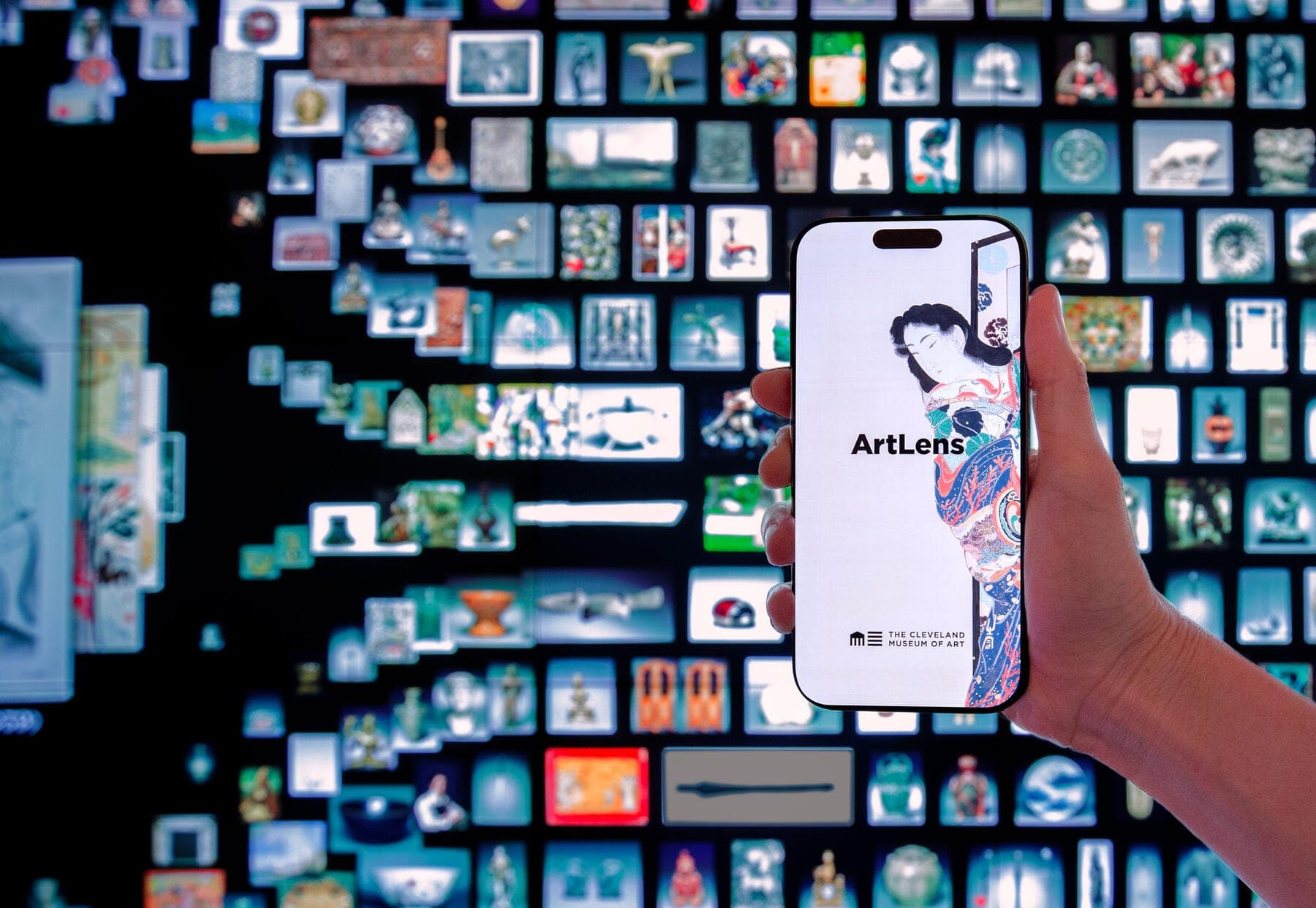
Photo courtesy of Dome Collective
Sponsors
Presented by


Principal support is provided by an anonymous donor.
Generous support is provided by BlueBridge Networks, CWRU Sears think[box], and LightSight AI. Additional support is provided by RealNose.ai.
All digital innovation and technology initiatives at the Cleveland Museum of Art are underwritten by the CMA Fund for Digital Innovation. Principal support is provided by the Bishop Parker Foundation, Mr. and Mrs. Tim Elek Jr., Walt and Kathy Fortney, Mr. William N. Hanson in loving memory of Susan H. Hanson, the Institute of Museum and Library Services, the late Mrs. Nancy M. Lavelle, John and Leanne Sauerland, and the Trilling Family Foundation.