Artwork Page for Eight Views of Xiao-Xiang

Details / Information for Eight Views of Xiao-Xiang

Eight Views of Xiao-Xiang

瀟湘八景図巻

1500s
(Japanese, c. 1492–c. 1577)
Measurements
Overall: 15.7 x 289.5 cm (6 3/16 x 114 in.)
Public Domain
You can copy, modify, and distribute this work, all without asking permission. Learn more about CMA's Open Access Initiative.
Location
Not on view

Description

Eight Views of the Xiao and Xiang Rivers can be traced to 11th-century Chinese poems and paintings, the depiction of which had also become popular among Korean and Japanese painters. Xiao-Xiang refers to the region in present-day Hunan province where the Xiao and Xiang rivers converge. Few painters of the Eight Views had in fact seen the scenery; rather, they were trying to portray in ink and wash the lyrical qualities of dim light and a misty atmosphere typical of that region. Each of the poetic titles suggests a time of day, a season, or specific atmospheric conditions—subjects that challenged the abilities of the most talented artists.

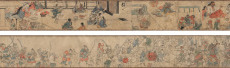
In this miniature painting (shukuzu) of the Muromachi period, Japanese Zen monk and painter Shukei Sesson depicted all eight views featured in Chinese prototypes: Wild Geese Descending to Sandbar; Returning Sails Off a Distant Coast; Mountain Market in Clearing Mist; River and Sky in Evening Snow; Autumn Moon over Dongting Lake; Night Rain on the Xiao and Xiang; Evening Bell from Mist-Shrouded Temple; and Fishing Village in Evening Glow.
A horizontally long handscroll features black ink on grey paper depicting a panoramic landscape of hazy mountains shrouded in mist. Dark ink washes define craggy rocks and tree clusters created with frenetic, black strokes. Toward our right, the terrain opens into a wide expanse of water with distant hills, small boats, and loose sketches of people. Pale gray washes contrast with sharp black strokes. A column of Japanese calligraphy appears on the far left edge.

Eight Views of Xiao-Xiang

1500s

Sesson Shūkei

(Japanese, c. 1492–c. 1577)
Japan, Muromachi period (1392–1573)

See Also
Visually Similar by AI

    Contact Us

    The information about this object, including provenance, may not be currently accurate. If you notice a mistake or have additional information about this object, please fill out the appropriate request form linked below:

    Update or Correct Artwork Information

    Imagery or Rights for Non-Open-Access Artworks

    Report a Website Issue

    Further Questions About This Artwork